



Telegram has spent years selling itself as the last refuge of digital privacy — the place where dissidents, activists, journalists, and ordinary people can speak freely without fear of surveillance. They brag about refusing government data requests, about “zero bytes” handed over, about being the anti‑surveillance platform in a world drowning in monitoring. But court documents told a different story.
The case of Mahmoud Amin Yaqoub al‑Muhtadi, known as Abu Alaa, makes that abundantly clear. Mahmoud is a Palestinian man from the Gaza Strip, born around 1991, and alleged by U.S. prosecutors to be affiliated with the National Resistance Brigades (NRB) — the armed wing of the Democratic Front for the Liberation of Palestine (DFLP). In Gaza, this is a resistance faction. It is part of the broader Palestinian armed struggle under occupation, not a criminal enterprise.
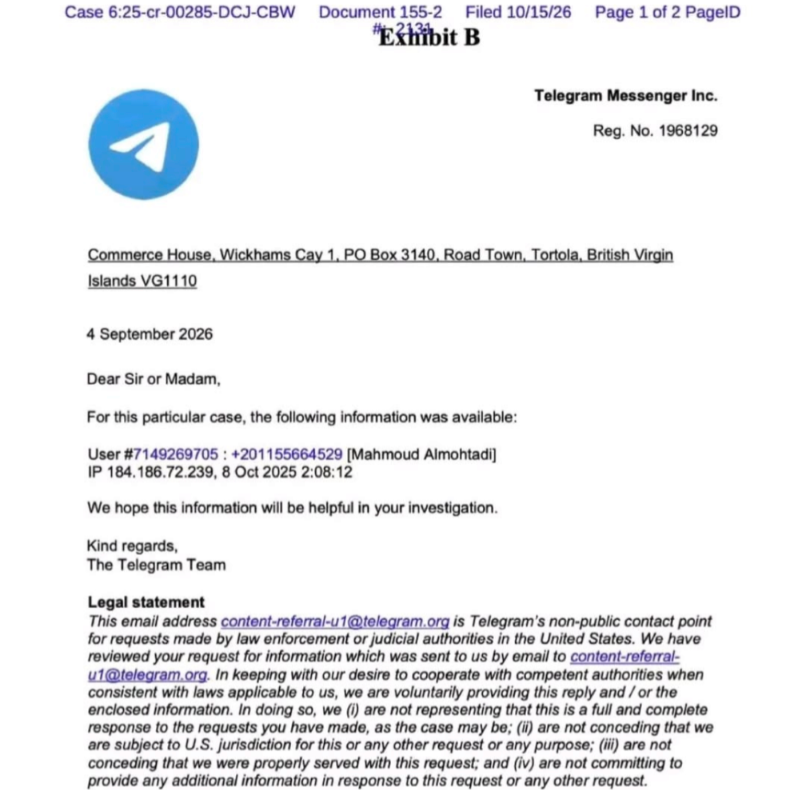
The U.S. government built its case using phone data, immigration records, intercepted communications, and — critically — Telegram account information. In the court file United States v. Mahmoud Yaqoub al‑Muhtadi, prosecutors included a formal certification from Telegram Messenger Inc., signed and dated, addressed directly to U.S. law enforcement. Telegram provided:
• User ID: 7149269705
• Phone number: +201155664529 (listed as “Mahmoud Almothadi”)
• IP address: 184.186.72.239
• Timestamp: 8 October 2025, 2:08:12
Telegram also confirmed that the email used for the request — content-referral-u1@telegram.org — is their non‑public law‑enforcement channel for U.S. authorities. They added a legal statement saying they were voluntarily cooperating with U.S. law enforcement. This is the exact opposite of Telegram’s public claims about refusing government data requests.
U.S. prosecutors allege that on the morning of October 7, 2023, Mahmoud coordinated with others and crossed into Israel. They claim phone‑location data placed a number associated with him near Kibbutz Kfar Aza, adjacent to the Gaza border, and cite intercepted calls they say show coordination with other fighters. Whether these claims are accurate or politically framed is a separate question — but the point is that Telegram data was used to support them.

Under international law — including principles derived from the UN Charter, the right to self‑determination, and decades of legal interpretation — peoples living under foreign military occupation have a recognized right to armed resistance. This isn’t fringe or rhetorical. It’s a legal principle. Armed resistance movements in occupied territories are understood within this framework. They are not defined by the language of “terrorism” used by occupying powers or foreign governments. They are defined by the legal right of a people to resist violent, prolonged, and unlawful occupation. So when prosecutors describe Palestinian resistance fighters as criminals or terrorists, they are using political language — not the language of international law, even if international law is a total farce.
The U.S. government also charged Mahmoud with visa fraud (18 U.S.C. §1546), claiming he lied on his 2024 visa application by failing to disclose his alleged affiliation with the NRB and alleged weapons training. According to court filings, he entered the United States on September 12, 2024, lived first in Tulsa, Oklahoma, and later moved to Louisiana, where he stayed until his arrest in October 2025. The case was filed in the Western District of Louisiana on October 17, 2025, and he was charged with material support (based on the U.S. designation of DFLP), visa fraud, and false statements. Telegram’s certification was part of the evidence used to build this case.
As of now, Mahmoud has pleaded not guilty to all charges. A trial date is set for January 25, 2027. The government filed a superseding indictment adding additional counts of conspiracy to provide material support and making false statements. He remains in custody, and his defense team has requested a hearing to ensure he can practice his religion while detained. The case is part of the Justice Department’s “Joint Task Force October 7,” which is targeting individuals they claim are connected to that day’s events.
Telegram markets itself as a fortress of privacy. But when confronted with government pressure, legal demands, or political cases, it hands over user data — phone numbers, IP addresses, timestamps, account identifiers — the exact data needed to track someone across borders. The case of Mahmoud Amin Yaqoub al‑Muhtadi exposes the gap between Telegram’s public image and its actual behavior. It also exposes how resistance movements under occupation are reframed through foreign legal systems, stripped of their international legal context, and prosecuted using data from platforms that claim to protect them.
When it comes to the U.S. and Israel, nothing is off-limits. People are not safe—stay cautious about what you share. Be vigilant.
I never got a telegram account, but I heard about it. I canceled my TikTok and Xaccount. I have removed Facebook and Instagram accounts from my phone, but I need to take it a step further and council those accounts. All I have left is YouTube and Substack. And these days Substack is also very suspect in terms of your free speech. They’re clamping down on free speech everywhere. The only other one I have and I trust is UpScrolled.
Thanks for the post. Been a whistleblower and about local corruption and been twisted abd bent over outrageous accusations, they love word "intent" imply theycan see through you, character assasignations. And the public ducks it up, sugg finally safe again. They want security looking in all the caring places. Police chief tells my neighbors he hasxa a thick file on me and attorneys only want to chase ambulances.