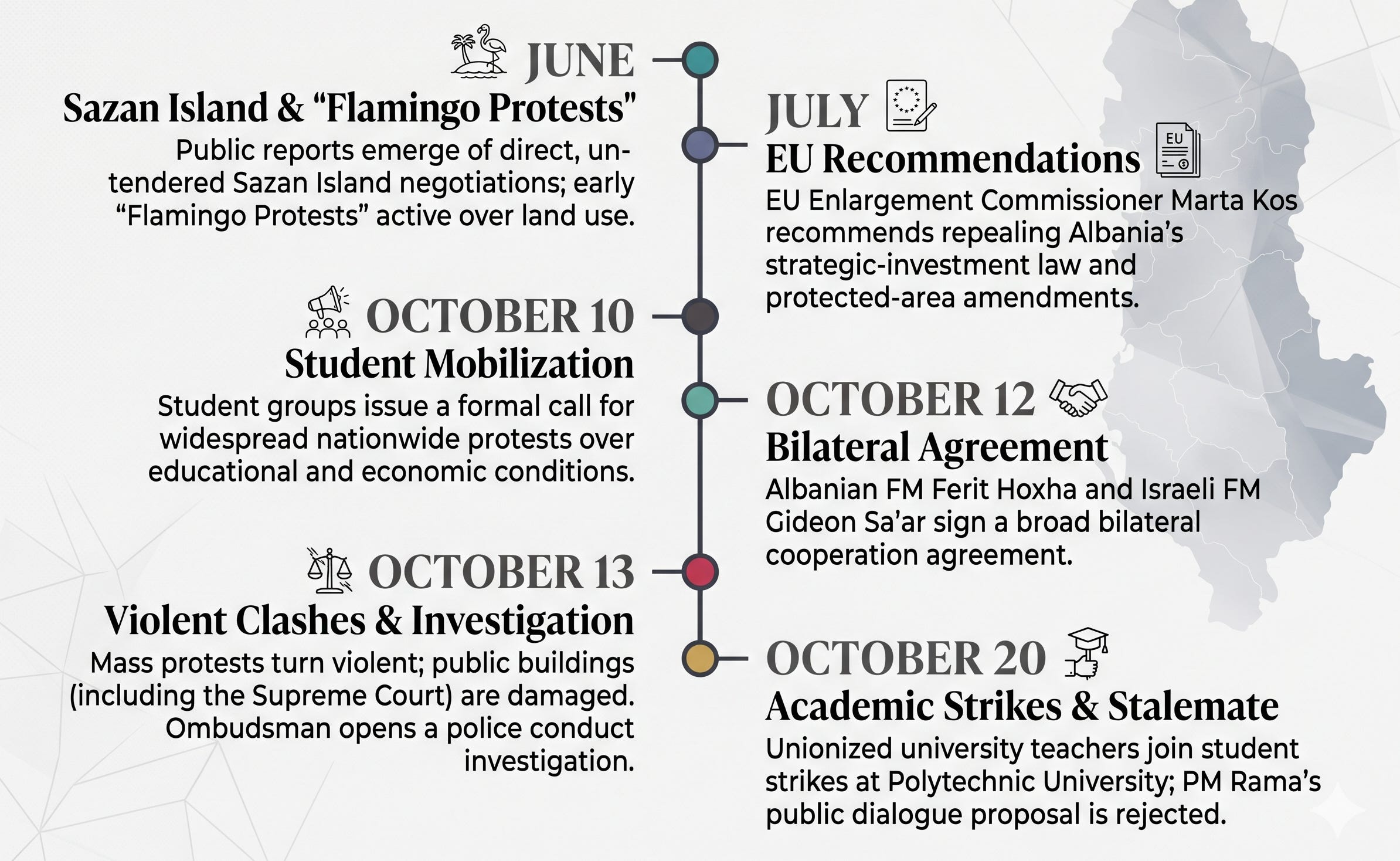
Albania is facing a political and social crisis with increased civil unrest from students and protests against the government of Prime Minister Edi Rama. The causes of this unrest can be attributed to several factors, including domestic issues, controversial land developments and recent foreign policy decisions.

Key reasons behind the current crisis and recent developments include:
Controversial Land and Resort Developments: The non-tendered development of high-end resorts (linked to Jared Kushner) on Sazan Island and Zvërnec along the Albanian mainland coastline is causing strong opposition from the public over the land issues, access and the environment.
EU Regulatory Dispute: European Enlargement Commissioner Marta Kos has demanded that Albania repeal its strategic investment law and changes made to protected areas in 2024. This has caused Rama’s development plans to clash with Albania’s efforts to join the European Union.
Major Social Movement: The issues with land development along the coast have merged with students protesting due to high university fees, lack of state funding, poor job prospects and overall higher living costs.
Diplomatic Deal with Israel: A wide-ranging deal between Ferit Hoxha and Gideon Sa’ar was signed on October 12th, which includes collaboration in various sectors and security. This deal has caused further outcry from the public as Rama has received praise from Israeli officials, and there is a perception that the Israelis are linked to the controversial resort developments.
State Funding and Bonuses: Prime Minister Rama has decided to offer police a bonus of €2,500 and pay rises for helping to manage the protests. He has also threatened students who do not dissociate themselves from the protests with losing state funding, scholarships and free education.
No Reconciliation: University lecturers participated with students outside the Polytechnic University on October 20th. The protestors have refused to engage in the government’s calls for dialogue, demanding that Rama step down. However, the government has blamed the protests on alleged interference from Russia, Iran and ANTIFA but has not provided any evidence publicly.
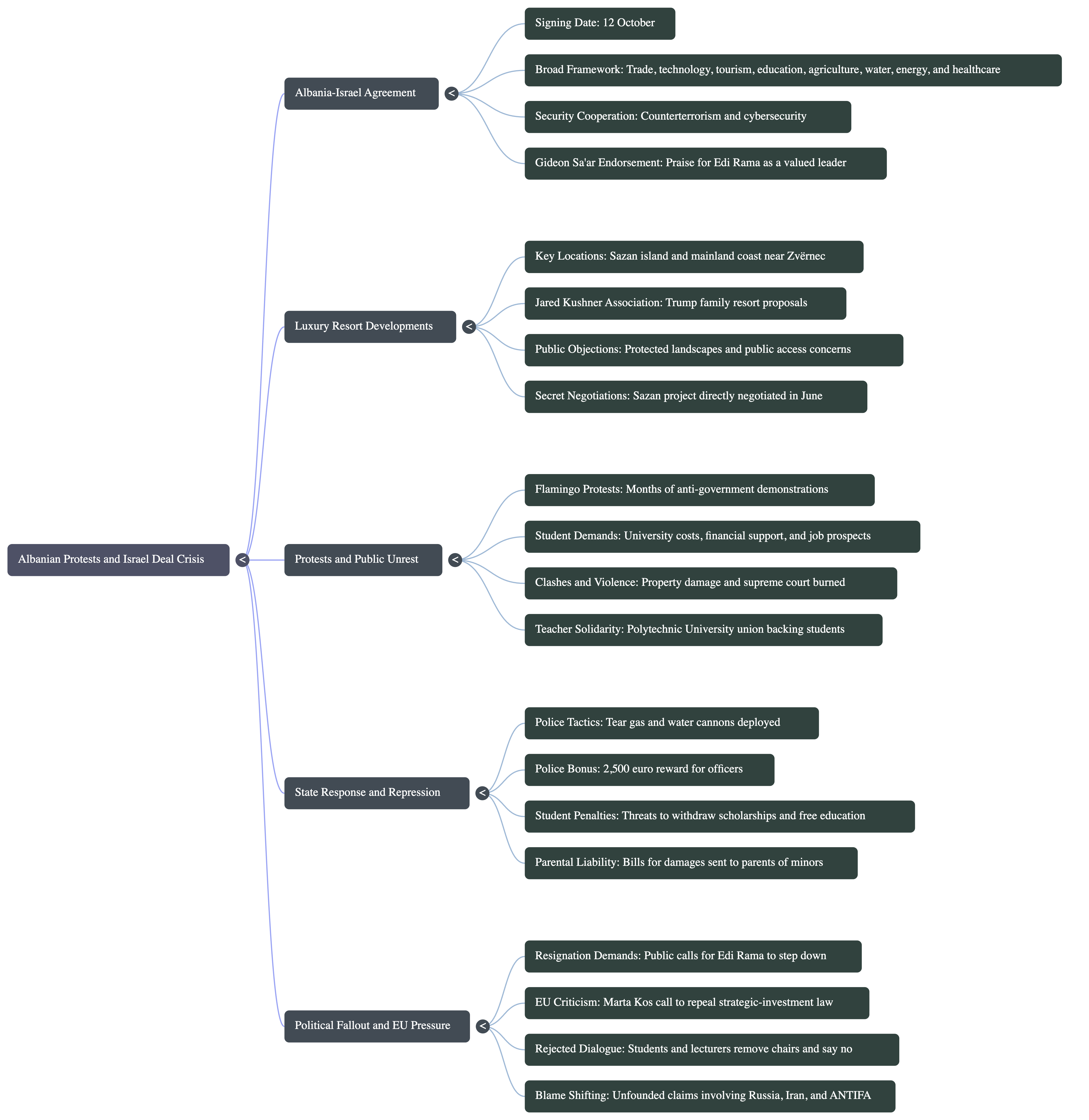
Key themes and events:
1. Land Deals, Foreign Investment and Tension with the EU
The root issues causing civil unrest are linked to land deals with foreign investors.
Sazan Island & Zvërnec development: A luxury resort was planned on Sazan Island and on the mainland near Zvërnec by the developer, Jared Kushner. However, these areas are highly valued ecologically.
No transparency: The development for Sazan Island was directly negotiated with the State in June, meaning no open tendering. Consequently, the terms, permits and details were not known publicly.
Concerns from the EU: As Albania wishes to become part of the EU, it has to meet European standards regarding the environment and land. In July, European Enlargement Commissioner Marta Kos called for the strategic investment law to be abolished, along with changes to the protected areas.
2. Students rise against economic crisis
A student movement has emerged to protest against this government policy (alongside an environmental and land-related issue (known as the Flamingo Protests)).
The main complaint was the high tuition fees for both university and accommodation, lack of financial assistance and no good career opportunities.
This then became a wider issue as many people were unhappy with the cost of living. This led to student organisations joining together with environmental activists and local communities affected by the coastal developments to create an anti-government group to call for the resignation of Prime Minister Edi Rama.
University lecturers who are part of the university workers’ union decided to support the students on 20 October outside the gates of the Polytechnic University. The lecturers called for unity to fight the state violence towards students and create academic protections.
3. Bilateral Agreement between Albania and Israel
The Albanian government signed an important diplomatic agreement with Israel amidst increasing domestic unrest.
The agreement was signed on the 12th of October by the Albanian Foreign Minister Ferit Hoxha and Israeli Foreign Minister Gideon Sa’ar.
The agreement outlines wide-ranging cooperation between Albania and Israel in non-security and security sectors.
Non-security sectors include trade, technology, tourism, education, agriculture, water, energy and health.
Security sectors include counterterrorism and cybersecurity. This builds upon previous technical assistance provided by Israel. In 2022, Albania experienced major cyber attacks, and Israel has now provided technical assistance in this area.
The agreement was publicly announced, but the details of funding were not specified. The agreement outlined general areas of cooperation between Albania and Israel.
The Foreign Minister argued that the agreement would provide long-term benefits to society by reducing higher education costs through academic cooperation. However, there was backlash from the public linking the agreement to the current issues with foreign investors. The Israeli Foreign Minister, Gideon Sa’ar, also publicly stated that Edi Rama was a “steadfast friend of Israel and one of the world’s most valued leaders”. This caused backlash from domestic opposition who wanted Rama to step down.
4. Police violence, incredibly, has risen after the Israeli deal.
The protests turned into serious civil disobedience with some damage to public property, including arson at the Supreme Court.
The state security forces used tear gas and water cannons to disperse people. However, on October 13, the national ombudsman opened an investigation into whether the police response was necessary and proportional.
Prime Minister Rama commended the police for their “courage and resistance” during the protests. He has also announced that those involved will receive a bonus of €2500, and will receive a pay rise earlier, in January.
Rama also announced he would take punitive action against those who did not cooperate:
Those students who do not distance themselves from violent groups will lose their scholarships, state funding and free access to the university.
Parents of minors who caused damage to property will be billed for the damage.
However, critics and legal experts point out that for students to lose their educational funding, there need to be evidence, legal grounds and an appeal process in place. Attendance at the protests cannot be used as a reason to penalise someone.
5. Political Deadlock and Failed Attempt at Reconciliation
Prime Minister Edi Rama has been firmly entrenched, claiming he has a mandate to stay in office and blaming others for unrest.
Foreign Interference Claims: Rama claimed, without providing the public with any evidence, that it was due to foreign interference from Russia, Iran and ANTIFA.
Rejecting ‘Fake Dialogue’: The Government tried to start negotiations with the public by placing chairs with the sign Dialogue outside the Prime Minister’s office. Students protesting and lecturers in the union refused to attend these fake talks and removed the chairs from outside the office. They reiterated that they wanted Rama to resign.
Parliament: There is much scepticism towards those in parliament who are opposing the prime minister. Protesters have claimed they do not trust any political party in the system and therefore traditional political changes will not help solve the issue.
TIMELINE OF KEY EVENTS