


We have hearts that grow tired, nerves that have limits, and breaking points just like every other human being in this world. We may endure for a day, a month, or a year, continuing to help one another despite fear, hunger, displacement, bombardment, and loss. But that does not mean we do not suffer, nor does it mean our ability to endure is endless.
Every human being has a breaking point.
When years of fear, losing loved ones, displacement, hunger, deprivation, anxiety about our families, interrupted sleep, and not knowing what tomorrow will bring pile up on a person, even the smallest problem can sometimes become the spark that ignites anger that has been buried inside for a very long time.
And this makes me think deeply about the way the world looks at our ability to endure.
There is a dangerous belief that Palestinians can withstand anything, that we will keep going no matter what happens, and that we can somehow live with genocide and destruction indefinitely. Perhaps this way of thinking is one of the reasons this tragedy continues, because when people are seen as capable of enduring everything, it becomes easier to ignore them when they finally say: We cannot do this anymore.
No, we cannot endure all of this.
We did not choose this life. We did not choose to live through war. We did not choose to lose the people we love, search for water, live away from our homes, or go to sleep without knowing what tomorrow will bring.
We were forced into this dark reality.
Throughout these years of war, people in Gaza have tried, despite everything, to maintain a great deal of discipline, stay away from conflicts, and help one another. I have seen this myself while distributing water in the camps.
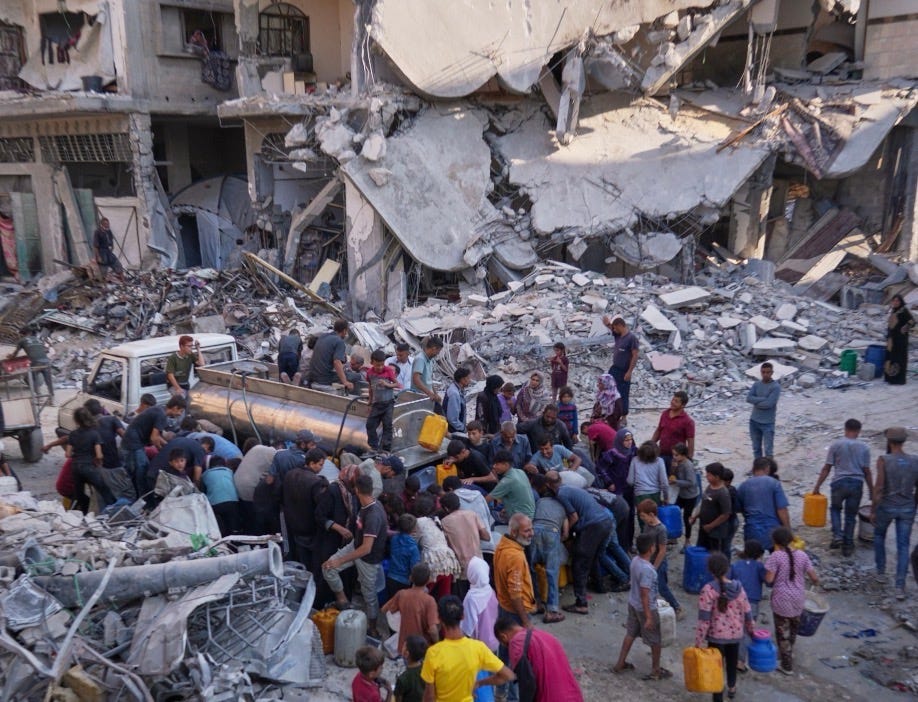
There have been many small arguments during distributions. Sometimes it would start with something as simple as, “It’s my turn,” and someone else would respond, “No, it’s my turn,” and then the voices would get louder and the tension would begin to rise.
But fortunately, there was something very important in most of these situations: the elders.
The young men would listen to them. The elders would intervene and ask both sides to calm down and reconcile. They would remind them that they were brothers, and that these circumstances should not turn them against one another.
They would tell them that this was a short-term hardship and that it would eventually pass, and that we must not allow it to divide us. We must remain united as one hand.
This is not unusual in Gaza.
Usually, when a conflict happens between people, the elders step in to calm things down before they escalate. There is always someone older who knows both families, or someone respected by the community, who steps in and puts an end to the dispute.
We understand very well that our division does not serve us.
And we understand that these conflicts between families do not reflect the true character of our people. The Palestinian standing next to you in a water line may be the same person who shares his bread with you tomorrow, helps you carry your tent, or searches with you for medicine for a child.
But when a person lives under constant pressure, they become more angry, more sensitive, and less able to tolerate even the smallest things.
And this is the reality the world needs to understand.
Suffering does not disappear simply because people are still standing.
You may see someone smiling, helping their neighbor, distributing water, or carrying a child, and assume that they are fine.
But inside, they may be completely exhausted.
They may have lost their home, their friends, and their relatives. They may not know where they will sleep that night, yet they still stand in front of you and try to help others.
That is not proof that we do not suffer.
It is proof that we are trying to remain human despite everything.
But even this ability has limits.
Today, a family fight broke out on the street where I live. It started hours ago and, unfortunately, escalated into something tragic. The death toll reached three people, with several others injured.
I do not believe there is a single Palestinian who could be happy to hear this news.
We do not want to see more bloodshed among ourselves. We do not want to lose people because of a disagreement that could have ended with a wise word or the intervention of an elder.
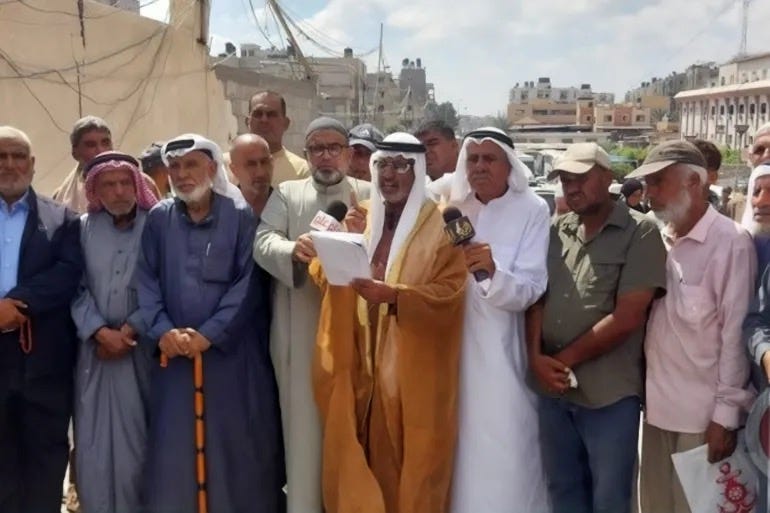
But there is one question we cannot ignore: How did we get here?
One important reason is the absence of an effective police presence, after police officers and police institutions have been repeatedly targeted during the war. When the system that used to intervene in such disputes disappears, it can become much harder to stop a conflict before it turns into a catastrophe.
However, I do not want my words to be understood as a justification for what happened.
Killing a human being is not a solution.
And anger is not an excuse for taking another person’s life.
But I want people to understand something else: when you push an entire society to the absolute limits of its endurance for such a long time, you cannot expect it to remain the same as it was before the war.
A human being is not a machine.
We have hearts.
We have nerves.
We have fear.
We have grief.
And we have a limit to how much we can endure.
When suffering crosses that limit, a person can break.
Perhaps this is why we should not look at what is happening inside Gaza as merely random disputes or family problems. Sometimes behind a single moment of anger are years of accumulated pain, days and nights of fear, and losses that a person cannot even put into words.
We need to help one another stay together, not simply blame one another.
We need to remember that we are all in the same boat.
We need to remember the words of the elders who used to intervene during the water distributions: We are brothers. This is a hardship, and it will pass. We must remain united as one hand.
But there is one last thing I want to say to those reading this from far away.
Do not look at our resilience and assume that we are fine.
Do not look at our smiles and assume that we no longer grieve.
Do not look at our ability to help one another and assume that the pain has become easy for us.
We help each other because we know what it means to be alone in this war.
We smile because we do not want to allow the war to take everything from us.
We endure because we have no other choice.
But even the strongest hearts have a point at which they break.
And many people have already reached that point.
So when you hear a Palestinian say, “We cannot do this anymore,” do not ask them to be stronger.
Listen to them.
When they say, “We are exhausted,” do not tell them, “You have gotten used to the war.”
Believe them.
And when you see us standing, do not assume that standing means we are not suffering.
We stand because we are trying to protect whatever remains of us.
In the end, perhaps the real question is not: How long can Palestinians endure?
But:
Why are Palestinians being asked to endure all of this in the first place?
We do not want to be heroes in a story about resilience.
We do not want to learn how to live without water, how to sleep under bombardment, how to bury our loved ones, or how to become accustomed to fear.
We simply want a normal life.
We want to live.
We want to return to our homes.
We want to see our families safe.
And we want the human being inside us to remain alive.
Because the most dangerous thing war can do to us is not only kill our bodies, but make us forget that we are brothers.
And that is why, in the middle of all this darkness, we must hold on to one another more tightly than ever.
Gaza may lose homes, streets, and so many things… but we must not allow this war to make us lose one another too.
This powerful and heart‑wrenching piece was written by Abood A, our North Gaza coordinator for the water distribution under Gaza’s Forgotten Families initiative. If you want to support him, please do so at the following link:
And for everyone who wants to support the Gaza’s Forgotten Families Initiative for the water distribution, please donate here:
This is a profoundly moving piece of writing, Abood. Thank you for writing it. Those words can’t have come easy. 🫂
I truly believe everyone needs to read this.
Palestinian resilience should never be mistaken for some unique superhuman powers. Your heart is my heart. Your body is my body. Your pain is my pain. Empathy is the only thing that makes us all human together.
This is just heartbreaking. We want to think that Palestinians are somehow superhuman and endure all the horror that is inflicted on them. But at the end of the day, we all need to remember they are just human. Just like you and I. 💔