


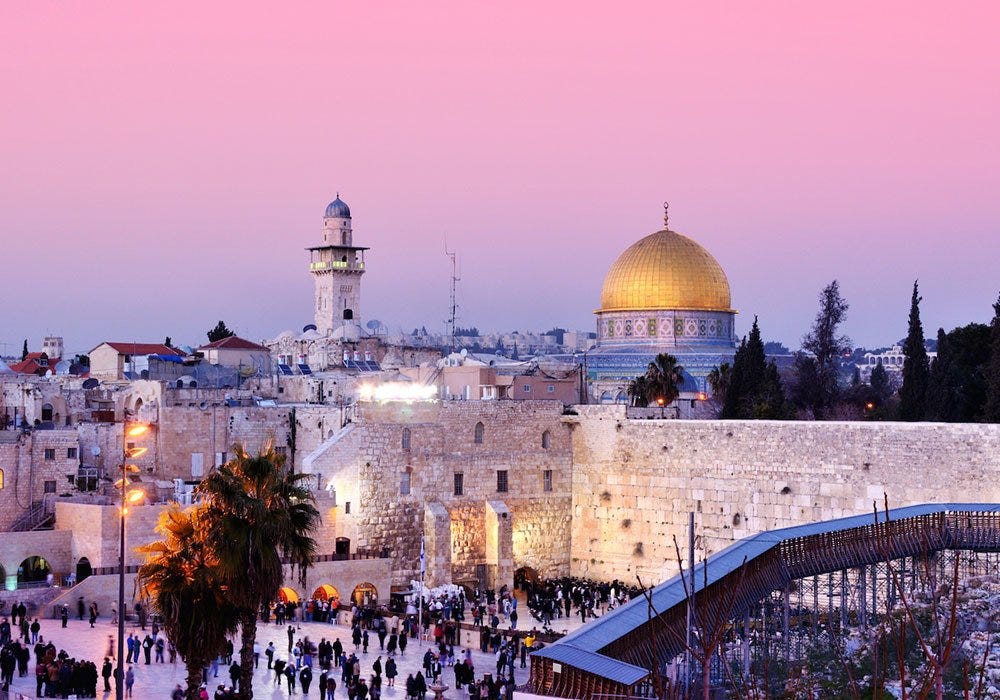
It’s ironic when people claim that Jews have an unquestionable right to modern political control over Jerusalem and Israel as a whole simply because a temple once stood there. That argument not only relies on theological mythology rather than historical fact, it also ignores the actual history of the region as revealed by modern scholarship, archaeology, and the continuous presence of indigenous people in the land.
For centuries, historians, including Jewish historians, did not regard the Hebrew Bible as a historical record. Isaak Markus Jost and Leopold Zunz, pioneers of modern Jewish historical studies, viewed the Old Testament as a theological text reflecting post‑exilic religious beliefs rather than a reliable account of ancient history. It wasn’t until nationalist historians like Heinrich Graetz in the late 19th century that the stories of Abraham, Moses, David, and Solomon were reframed as national history. Zionist historians later institutionalized these biblical “truths” through constant repetition in education and politics.¹
But archaeology tells a different story. The so‑called Exodus out of Egypt? No archaeological evidence. The conquest of Canaan? No record or trace. And the grand kingdom of David and Solomon? Archaeology points instead to two small, competing kingdoms: Israel in the north and Judah in the south, both marginal players in the ancient Near East, not the mighty united kingdom described in scripture. The First Temple itself? Still no definitive archaeological evidence that it existed at all, despite decades of politically motivated excavations around the Temple Mount.
As for the idea of Jews being “exiled” from Judea by the Romans, that is another myth. Historian Israel Yuval and archaeologists featured in Exile: A Myth Unearthed explain that Rome never enacted a policy of mass expulsion from Judea. Yes, Jerusalem was destroyed in 70 CE, and some elites were enslaved or killed, but the Jewish population largely remained in the land, especially in Galilee. Even after the Bar Kochba revolt (132–135 CE), Jews continued to live, thrive, and develop their culture in Palestine, culminating in the compilation of the Mishnah under Rabbi Yehudah HaNasi.² ³
In fact, the idea of a mass Roman exile was retroactively projected onto history using Biblical motifs of earlier Babylonian and Assyrian deportations. It was a myth created to explain the Jewish diaspora, not an actual historical event. As Le Monde Diplomatique summarizes, the diaspora was more a result of centuries of migration, trade, and religious proselytizing than forcible exile.¹
And here is what these myths conveniently leave out: Palestinians today are the indigenous descendants of all the peoples who lived in the region across millennia, including the ancient Hebrews. The original Jews were indigenous to Palestine; over centuries, many converted to Christianity and then to Islam following the Arab conquests. The idea that there is a clean break between “ancient Jews” and “modern Palestinians” is itself a Zionist fabrication meant to erase Palestinian indigeneity. The people Zionism displaced are not foreigners, they are the living continuation of the land’s original inhabitants, culturally, ethnically, and genealogically linked to the Jews of antiquity.
So no, the existence of a temple (for which direct archaeological evidence is lacking) over 2,500 years ago does not entitle a modern ethno‑nationalist state to colonize or displace the people who have continuously lived in that land. Historical myths, no matter how deeply ingrained, are not land deeds.
The claim that Jews cannot be “occupiers” in Jerusalem because of a supposed uninterrupted, ancient ownership is not only wrong, it is a weaponization of myth over fact. History is not a divine real estate contract. And no amount of biblical storytelling changes the reality that Palestine has been home to indigenous Palestinians, descendants of the very same ancient peoples Zionism claims to represent, all along.

It is ironic that they destroyed a synagogue in Tehran. And unexpected for me that they had one.
Brilliant, thank you. It will be interesting to watch whether christian zios double down on the myth-as-history or whether some are prepared to have a rethink and realise they have been duped, rather like Santa Claus turning out to be a tired sweaty man earning extra money over the holiday season, only with far worse damage. It is time to wake up and know the real history. The appropriation of a myth for land theft and the genocide of indigenous people is bizarre and wrong. This is the christian crusades all over again - barbarians muscling up for human rights crimes committed in the name of religion. I am sick to boiling point of these religious - jewish and christian - fantasies being used to defend theft, rape, and genocide. Anyway, thank for the summary. So real and so true. It is time for everyone to stop associating the word Israel with anything holy.