



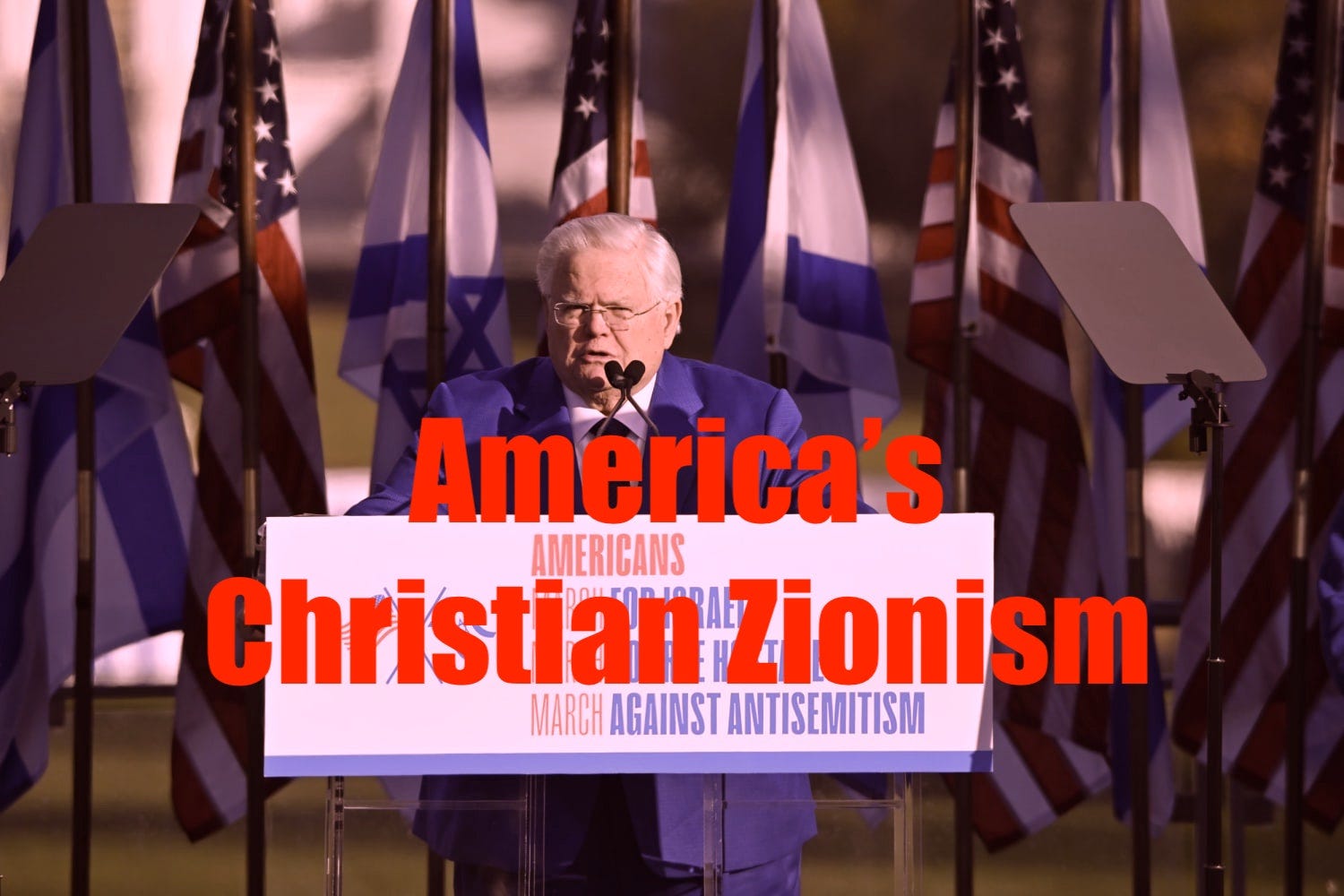
How can a faith that professes to embody God’s unconditional love support the most brutal acts of humanity, livestreamed? How can a religion that prides itself on selfless giving, saving lives, and pious living stand by, watch, and support the brutal annihilation of an entire people right before their eyes? The reason for this maddening dissonance is rooted in deep fear-programming within American Evangelicalism. I know this intimately because I was once a victim who broke free from the spell.
My Personal Journey Out of Hell
I was deeply immersed in my Christian faith.
A devout worshipper.
I loved, and still love God with my whole being.
I belonged to an all-Black Pentecostal Holiness church, where I learned about the power of faith and the living Word. I witnessed healings, miraculous interventions, financial breakthroughs, and moments that felt like heaven opening on earth. Being a woman hungry to please God, I was easy prey for hypnotic Word of Faith teachings that fused rhetoric with displays of power. In my mind, if the power was real, then God must be present.
What I couldn’t yet imagine was that corruption and miracles could coexist, that humans could stand amid what seemed like God’s power and still twist it for their own ends. That was the seed of a dissonance that would take me more than three years to escape.
Inside the church, that dissonance was easy to ignore because we all breathed the same air of duality. We were in the world but not of it. Our bodies belonged to earth, but our souls were citizens of a higher order—a divine operating system. We were taught that we possessed superior insight, a “discernment” unavailable to unbelievers. The Holy Spirit, we were told, guided every thought, whispering through Scripture and inner impressions.
But the language of guidance was elastic—vague enough to be shaped by whoever held the microphone. When right and wrong were reduced to “what pleases God,” interpretation became control. All it took were a few sacred trigger words—chosen, obedience, blessings and curses, the will of God—to keep entire congregations self-policing.
We monitored ourselves and one another, scanning constantly for invisible blemishes to purify, seeing demons in every doubt, striving to earn a love that was already promised but never felt. The result was a community primed for manipulation—hearts sincere, minds pliable, obedience guaranteed to whoever was anointed “leader.” That was my spiritual training ground.
The Fracture
When the world locked down in 2020 and our collective gaze shifted online, I watched the dissonance I had long ignored metastasize. Donald Trump turned outrage into liturgy, and American Evangelicals called it revival. I watched believers defend the indefensible; cruelty, vulgarity, violence, racism, because they had been conditioned to equate power with divine favor.
The harder they twisted to justify him, the clearer the truth became: the faith I loved had been hijacked. My excuses ran out. Their devotion to his depravity broke the last tether of my denial.
That rupture began my deconstruction.
For the next three years, I questioned everything; every verse, every sermon, every fear. My only compass was the rule I had once recited without understanding: God is love. That single truth became my doorway out of hell.
It was agony. Each time I doubted, Scripture surfaced in my mind like a weapon; verses of wrath and warnings of apostasy. I would fall asleep terrified that God might kill me for thinking. I woke relieved just to be alive. Alone, I wrestled with a God who no longer fit the cage I’d been given, until love, not fear, became the only voice I could trust.
I understand why many Christians watch what’s happening to the Church and yet feel powerless to intervene. For some, belonging to the collective matters more than truth itself. The thought of being ostracized, cut off from community, family, or salvation, feels more unbearable than death. Breaking free from mental and spiritual control is terrifying.
But this is where the rubber meets the road: every believer is called to heed God’s Word even in the face of persecution. And persecution does not always come from outside the Church; it often comes from within it. That is the true test of love, whether our devotion is to God or to our own ego’s need for acceptance.
Those who remain bound to Christian Zionism are not merely trapped in false doctrine; they are clinging to identity, power, and belonging. They have chosen ego over love. And this is the mirror now confronting American Evangelicalism: a movement that once preached freedom has become terrified of it.
What the Elites Did to Evangelicalism
When I say American Evangelicalism was hijacked, I don’t mean a single coup. I mean a slow, deliberate rewiring of the American Christian soul. In the early twentieth century, the ruling class saw that religion could move the masses more effectively than any policy. The pulpit reached where propaganda couldn’t, into the human soul, where eternity could be held hostage for obedience.
So the establishment began to merge faith with nationalism, Jesus with empire, and salvation with obedience. Over decades, as the ruling class strategically weaponized media and theology schools, the message of Christ was replaced by the myth of the chosen nation. Evangelicalism, once a grassroots spiritual movement, was remodeled into a psychological operation serving geopolitical agendas.
The Cold War sealed the deal. Anti-communism became the new gospel; Israel became the proxy of divine prophecy; and the “free world” was cast as God’s army against evil. Churches became distribution centers for state ideology, while congregants believed they were defending God Himself.
Follow the Money: The Architects of Influence
Behind the curtain stood industrial titans and political strategists who understood that controlling belief is the highest form of power. Figures like John D. Rockefeller and J. P. Morgan financed advertising campaigns promoting premillennial dispensationalism, a theology that fused American patriotism with end-times prophecy. Think tanks, oil magnates, and intelligence-linked foundations built new seminaries, media networks, and prophecy conferences.
This theology, later branded as Christian Zionism, turned unconditional love into conditional allegiance. To bless Israel was to bless God; to question Israel was to curse Him. A faith once centered on mercy was converted into a machine that sanctified militarism, apartheid, and silence in the face of genocide—because it was “God’s plan.”
The Manufactured Dissonance
To maintain control over millions of sincere believers, the architects of this system didn’t need to silence conscience. They just had to confuse it. The simplest way to do that was through dualistic thinking.
They split the world into:
Good vs. Evil
God’s side vs. Satan’s side
Us vs. Them
Once that binary is established, the ruling class can accomplish any goal by plugging in their agenda as “Us/Good” and manufacturing an enemy as “Them/Evil.” Evangelicals traded their discernment and picked a team.
This is the engine of cognitive dissonance: the mind cannot hold both love and hatred, mercy and murder, at once. So it resolves the tension by spiritualizing cruelty. Bombs become God’s weapons against evil. Empathy becomes a trick of the “enemy.” To question the system or form an original thought becomes rebellion against God Himself.
It’s a closed circuit where fear masquerades as faith. The dualism gives believers the illusion of moral clarity while stripping them of moral agency. The enemy is always “out there,” never within. And as long as people believe that, the architects of power remain untouchable.
Evil by Design: How Islam Became the Devil
With dualistic thinking installed, the ruling class input Islam into “Them/Evil” parameters. And the Middle East conflict was birthed and legitimized.
For centuries, Islam had been Christianity’s mirror: another faith claiming devotion, discipline, revelation. Believers rooted in love saw Muslims as brothers and sisters in faith, but Evangelicals hypnotized by fear became prey to spiritual propaganda. Islam became the enemy of God in their eyes.
Preaching verses like “Come out from among them, and be ye separate” (2 Corinthians 6:17) easily set up walls between brothers, and Islam morphed from a different religion into the enemy of God. The vague “Have no fellowship with the unfruitful works of darkness” (Ephesians 5:11) became potent when Islam was assigned the role of darkness. Islam was the Devil’s religion, and Muslims became the living symbol of “evil.”
Old Testament warnings about Babylon and about Gog and Magog were redrawn onto modern maps—reinterpreting Ezekiel 38–39 and Revelation 20—turning spiritual struggles into geopolitical policy. Muslims became the prophetic armies of Gog and Magog, the end-time threat to God’s people.
Every war in the Middle East was holy, and every bombing campaign became a strike against Satan himself. The dualism was complete: “we” were God’s soldiers; “they” were demons. The tragedy is that this story didn’t arise from Scripture. It was engineered—a psy-op that weaponized fear to keep believers loyal to empire and blind to empathy. And in that blindness, the unconditional love of Christ was quietly crucified again.
From Prophecy to Profit: How Zionism Became a Bankroll
Once the moral battlefield was drawn, money began to flow along its fault lines. If Islam represented evil and Israel represented God’s chosen army, then supporting Israel became an act of worship.
Televangelists capitalized on end-times eschatology with every war, pounding Armageddon into evangelical souls at “prophecy conferences” and “Bless Israel” nights. Congregants were told that every dollar sent to the Holy Land would hasten Christ’s return, while being reminded of the blessings and curses of siding with Israel. These campaigns grew into a billion-dollar network of Christian-Zionist nonprofits, church foundations, and donor ministries linking American pews to West Bank settlements.
Tax-exempt organizations collected tithes for “relief” projects that, in practice, underwrote settlement housing, security walls, and infrastructure on occupied land. Through conduits such as the Central Fund of Israel and partner ministries, believers were promised that to “build homes for God’s chosen” was to build their own blessing.
Then came the airlifts.
Beginning in the 1980s through the 1990s, Christian ministries launched “bring the elderly Jews home” campaigns, funding charter flights that relocated impoverished Russian and Eastern European Jews to Israel. The marketing was emotional: frail grandparents clutching Torah scrolls, returning to Zion before the Messiah’s arrival. For donors, it was prophecy fulfilled in real time. For Israel, it was demographic strategy disguised as humanitarian grace. Each campaign repopulated settlements under the banner of biblical compassion.
At the same time, churches began running Holy Land tours that turned faith into a tourism economy. Thousands of pilgrims walked where Jesus walked, unaware that their spending fed the occupation regime and agenda. The experience was engineered to graft spiritual attachment to political loyalty: believers returned home convinced that defending modern Israel was defending God Himself.
Evangelicals funded their own propaganda. Behind the pulpits and tour buses stood lobbyists and PR firms who understood that weaponized fear was a powerful renewable resource. Every prayer breakfast, every “Stand with Israel” gala, every photo of an elderly immigrant stepping off a plane became moral currency.
By the 2000s, the merger was complete: American piety supplied the optics, money, and moral cover; Israeli power supplied the narrative of divine destiny. The settlements thrived not merely on bulldozers and permits but on a theology that equated possession with prophecy. The occupation had become a sacrament.
The West Bank Settlements – A hidden Money Laundering Racket
Most of the world watches as the Israeli Occupation Forces (IOF) raid the West Bank under the pretext of “security,” evicting Palestinian families so their homes can be seized and resettled. What’s less visible is the money trail connecting American evangelical donations to Israeli real-estate interests.

The homes taken from Palestinians aren’t simply handed to settlers; they’re sold at market rates—yet none of the proceeds reach the dispossessed owners. For generations, Palestinians have faced a rigged permit system—less than 1 percent of building requests in Area C are approved—leaving them branded as “illegal” residents on their own land. When Israeli authorities invoke those fabricated infractions, the IOF carries out “legal” evictions that strip Palestinians of both property and rights.
Once the residents are expelled, the land is re-classified as Israeli property. Sales to settlers are then brokered by state-linked bodies and implemented through developers or settler NGOs. Funding for these purchases often originates abroad, via U.S.-based tax-exempt organizations such as One Israel Fund and Friends of Ir David—charities that funnel millions into settlement construction and property acquisition.
For Christian Zionists, these transactions are celebrated as the fulfillment of biblical prophecy—the restoration of the “Promised Land.” In practice, they underwrite an expanding Greater Israel project that displaces Palestinians with impunity while converting theft into real-estate profit and divine narrative alike.
Daniella Weiss – West Bank Settlement Architect
Daniella Weiss is a veteran Israeli settler leader who pioneered a rapid-expansion method for illegal settlements on occupied West Bank land. She co-founded Nachala, an organization that supplies logistics, fundraising, and political pressure to establish new outposts and enlarge existing settlements. Nachala raised money under banners such as the “National Fund for the Building of Eretz Israel,” and its activists have traveled to the United States to solicit donations from groups including Americans for a Safe Israel, sometimes using crowdfunding channels tied to religious networks such as Chabad.
Nachala’s field operations revolve around creating facts on the ground: the group mobilizes young couples, students, and volunteers to occupy targeted hillsides with tents, caravans, or abandoned farmhouses. These makeshift encampments—often set up overnight—quickly grow into permanent outposts. Another tactic is to establish small “agricultural farms,” which require little capital but extend control over large tracts of surrounding land. Many of these outposts sit beside Palestinian villages, where settlers—backed by Israeli army patrols and permissive enforcement—use roadblocks, intimidation, and occasional violence to push Palestinians away from their fields.
Although such activity is illegal under both Israeli and international law, Nachala has largely evaded consequences. Its close ties to right-wing ministers and sympathetic local councils allow it to lobby for retroactive legalization of outposts once Israeli families move in. The state then reclassifies the land as part of an approved settlement, effectively converting an unlawful seizure into “legal” Israeli property.
Since the 1990s, Nachala-style outposts and allied farm initiatives have multiplied across the West Bank. According to Peace Now and Kerem Navot, roughly 786,000 dunams—about 14 percent of the West Bank—have been declared “state land” through this expansionist model, turning temporary encampments into the architecture of permanent dispossession.
Call to Christians to Return to God
The current genocide and land grab were not accidents. This was a campaign slowly curated over a century, and Christian Zionism is the backbone of its success. The ruling powers hijacked the message of Christ to bring hell to earth—and the people of God played right into its plans. An awakening is stirring in the church: many are leaving institutions and returning to a relationship with God in purity. The grip that religious dissonance has on evangelicals is not small and deserves a hard look at the power behind religious abuse. Still, it’s time for the world to hold up a mirror to Christians everywhere and ask, “Who are you serving?”


