


For decades, Israel and its defenders have tried to describe the West Bank as “disputed territory,” as if its legal status is open to interpretation or dependent on political preference. That framing collapses the moment one looks at the law. Under the UN Charter, the Hague Regulations, the Fourth Geneva Convention, customary international law, and repeated rulings from the International Court of Justice, Israel’s rule over the West Bank, including East Jerusalem, is not a legitimate sovereignty claim. It is a military occupation, and one that has become unlawful through annexation, settlement expansion, and the denial of Palestinian self-determination.¹
The debate that continues in media and politics is not a legal debate. It is a political effort to obscure what the legal system has already made plain.²
The West Bank Is Occupied Territory Under International Law
Occupation has a specific legal meaning. Under the 1907 Hague Regulations and the 1949 Fourth Geneva Convention, a territory is occupied when it is placed under the effective control of a foreign military power without lawful transfer of sovereignty. That definition fits the West Bank exactly. Israel controls borders, movement, land registration, natural resources, airspace, security, and the lives of millions of Palestinians who did not consent to its rule.
No recognized legal body has accepted Israeli sovereignty over the West Bank. Israel captured the territory in 1967, but conquest does not create lawful title under modern international law. Military control does not become ownership simply because it lasts a long time.
The United Nations Human Rights Council concluded in its 2023 legal study that Israel remains the occupying power and that its continued presence violates the legal limits governing occupation. The International Court of Justice reaffirmed in 2024 that the West Bank is part of the Occupied Palestinian Territory and that Israel’s authority there is one of occupation, not sovereignty.¹
Occupation Is Temporary by Law, but Israel Made It Permanent by Design
International law allows occupation only as a temporary wartime condition. The occupying power may administer territory for security reasons while awaiting a lawful political resolution. It may not exploit the territory, transfer its own population into it, permanently alter its character, or annex it.
Israel’s occupation has lasted nearly six decades. During that time, it has embedded control of the West Bank into state institutions, infrastructure systems, military planning, and domestic politics. Roads are built to connect settlements to Israel proper. Water systems are controlled unequally. Land is fragmented into isolated Palestinian enclaves while Israeli settlers move freely under civilian law.
When an occupation ceases to be temporary and becomes a system of permanent domination, it loses the legal protections occupation law was meant to provide. Scholars and legal analysts increasingly describe Israel’s rule as an unlawfully prolonged occupation because it has transformed temporary military control into a durable political order.²
Israel’s Settlements Are Illegal and Constitute a War Crime
The clearest legal issue of all may be the settlements. Article 49(6) of the Fourth Geneva Convention states: “The Occupying Power shall not deport or transfer parts of its own civilian population into the territory it occupies.”
This provision was created precisely to stop colonization under military occupation. Israel has nevertheless built and expanded settlements across the West Bank for decades, moving hundreds of thousands of Israeli civilians into occupied land while displacing Palestinians through confiscation, demolitions, permit denials, and violence.
The United Nations Security Council, the International Committee of the Red Cross, Amnesty International, Human Rights Watch, and the International Court of Justice have all affirmed that the settlements violate international law. Under the Rome Statute of the International Criminal Court, transferring civilian population into occupied territory is a war crime.³
This is not controversial among serious legal institutions. It is only controversial among governments determined to shield Israel from consequences.
De Facto Annexation Is Still Annexation
Israel formally annexed East Jerusalem after 1967, a move rejected internationally as null and void. But formal declarations are not required for annexation. States can annex land through facts on the ground.
That is what Israel has done throughout the West Bank through settlement blocs, segregated road systems, land seizures, military zones, legal dualism, and permanent administrative control. Israeli settlers live under Israeli civil law. Palestinians living nearby remain under military rule. One population enjoys rights, infrastructure, and political representation. The other is denied all three.
The Office of the United Nations High Commissioner for Human Rights has described these policies as creeping annexation. In 2024, the International Court of Justice concluded that Israel’s policies and practices amount to unlawful annexation.⁴
Annexation does not become lawful because it is gradual.
The Separation Wall Was Ruled Illegal
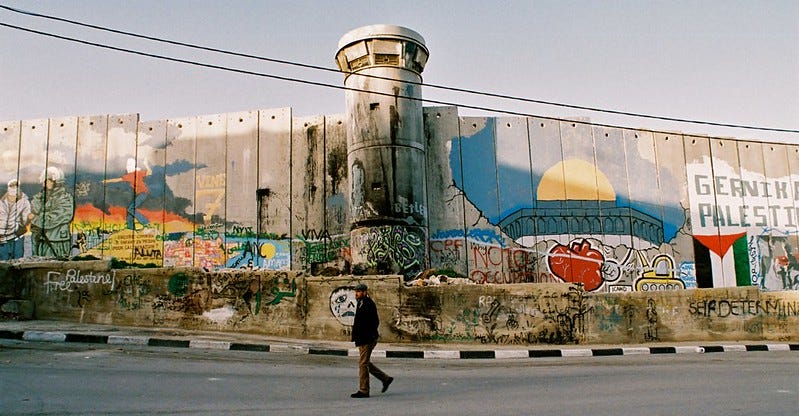
In 2004, the International Court of Justice ruled that Israel’s separation wall in the West Bank violated international law. Much of the route does not follow the Green Line but cuts deep into occupied territory, enclosing settlements and isolating Palestinian communities from farmland, schools, jobs, and medical care.
The Court found that the wall violated freedom of movement, property rights, and the Palestinian people’s right to self-determination. It ordered that sections built inside occupied territory should be dismantled and that harmed persons should receive reparations.⁵
Israel ignored the ruling. Ignoring a judgment does not erase it.
Human Rights Law Applies in Occupied Territory
Israel has often argued that human rights treaties do not apply in occupied territory. That position has been repeatedly rejected. The consensus of international legal bodies is that both humanitarian law and human rights law apply simultaneously during occupation.
That means Israel remains bound by treaties protecting civil liberties, children, freedom from torture, housing rights, due process, and equality before the law. Yet the documented reality in the West Bank includes arbitrary detention, child imprisonment, home demolitions, land confiscation, movement restrictions, settler violence often carried out with military protection, and systematic discrimination in planning and resource access.⁶
These are not isolated abuses. They are structural features of the system.
The 2024 ICJ Opinion Removed All Remaining Doubt
In July 2024, the International Court of Justice issued one of the most significant rulings in the history of the conflict. It held that Israel’s continued presence in the Occupied Palestinian Territory is illegal and must end as rapidly as possible. It further stated that all states are obligated not to recognize the illegal situation, not to aid or assist in maintaining it, and to cooperate to bring it to an end.⁷
That is not activist rhetoric. It is the highest court in the international system stating that the occupation itself has crossed the line from temporary military control into unlawful domination.
The Real Question Is Not Legal but Political
The legal record is overwhelming. The West Bank is occupied territory. The settlements are illegal. Annexation is illegal. The wall was ruled illegal. Prolonged occupation aimed at territorial acquisition is illegal. The denial of Palestinian self-determination is illegal.
So the real question is no longer whether the occupation violates international law. It does.
The real question is why powerful states continue to fund, arm, excuse, and normalize an unlawful system after every major legal institution has already spoken.
And no one is doing a thing about it. This encourages continued lawlessness. It's why I question Hamas and Hezbollah being called "terrorists". Are they? Or are they desperate people with nowhere to turn.
Israel is a military base that masquerades as a country. Situated on Palestinian land.
Every israelian serves 3 years in military service.
3 years of being barked at by an aggressive commander....
Thats how you create a society of genocidal maniacs.