


Four governments have spent a year trying to broker a ceasefire. Two of them arm opposite sides of the fight, a third arms the second — and the fourth, which convenes the table, is the arms dealer to most of it.

As of mid-July 2026, the deadlock is almost absurd in its symmetry. The RSF has agreed to an unconditional three-month humanitarian truce under UN supervision but rejects any withdrawal from the territory it holds, while the army-led government demands a full RSF withdrawal from every city seized since May 2023. Both sides filed written responses to the U.S. proposal this month, and Washington’s envoy spent the week tamping down reports of a breakthrough, warning that “multiple substantive issues” remain unresolved. This is the fourth serious framework in three years, and like the three before it, it is stuck. The easy explanation is that two generals would rather fight than share power. The truer one is that the countries doing the mediating are the same ones keeping the war supplied.
The Quad

The diplomacy runs through an ad hoc group of four. On 12 September 2025, the U.S., Saudi Arabia, Egypt and the UAE — the “Quad” — announced a roadmap: a three-month humanitarian truce leading to a permanent ceasefire, followed by a nine-month political process toward a civilian-led government. The statement was pointed about who should not run Sudan: its future, it said, “cannot be dictated by violent extremist groups part of or evidently linked to the Muslim Brotherhood.” On paper it was a breakthrough — the first time the outside powers with the most leverage had agreed on an endgame. Then the fighting continued, and the truce never arrived.
The conflict of interest at the table
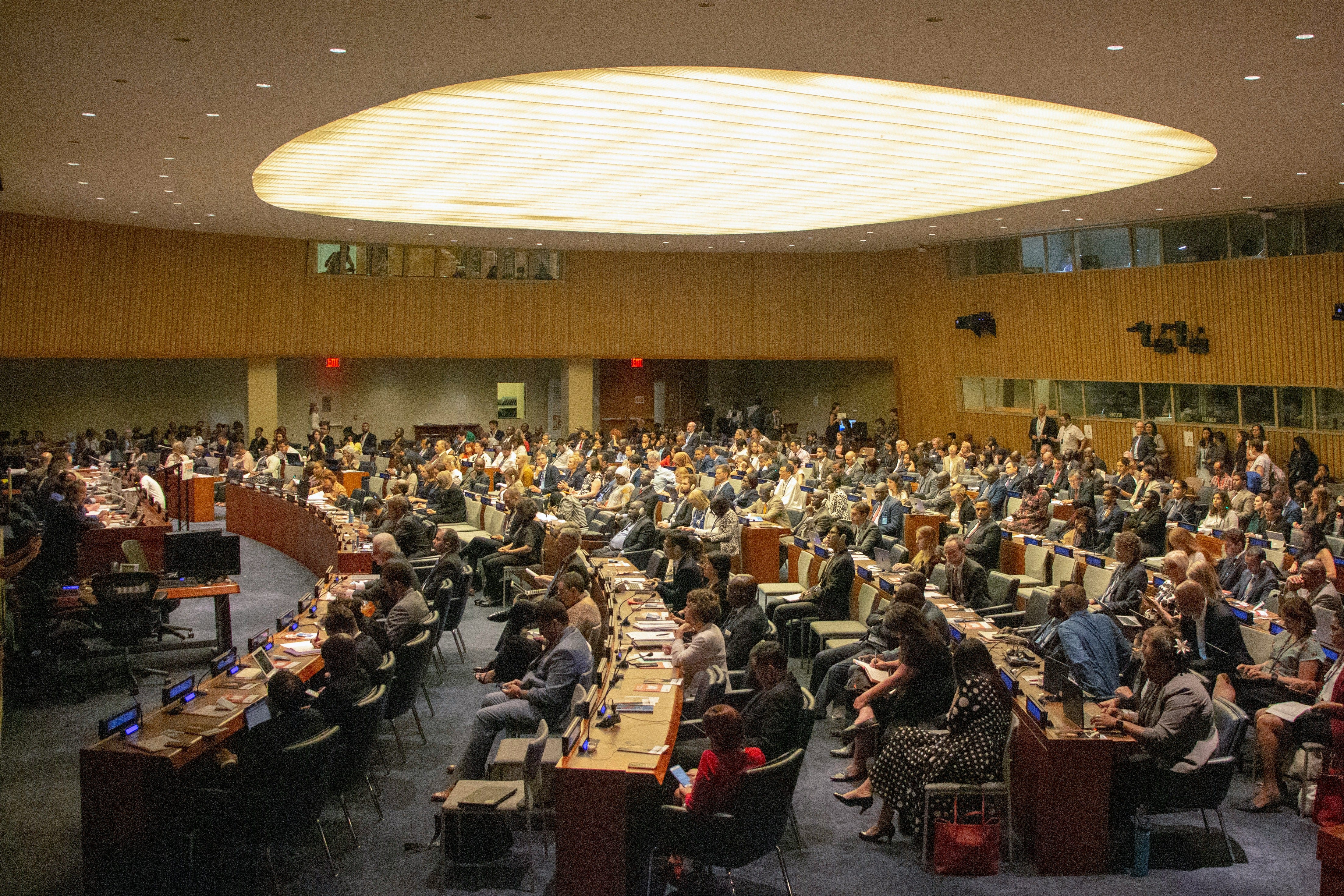
The Quad cannot force a ceasefire because the Quad is not a neutral body — it is a table of interested parties.
This series has documented the arming: the UAE, widely assessed to supply the RSF (which it denies); Egypt, hosting the drone base that strikes the RSF for the army; and behind the UAE, a United States that keeps selling it weapons. The critique is not fringe. The Atlantic Council put it bluntly: peace efforts have failed because the mediating Arab states “are not acting in good faith but are supporting opposing sides.”
The split runs straight through the group.
In other words, two of the four “mediators” are backing opposite sides at the table itself.
And the government convening it is the armorer of most of it.
The United States is the largest arms supplier to three of the Quad’s four members: a record $142 billion arms deal with Saudi Arabia in May 2025, the largest in U.S. history; continued sales to the UAE, including a $1.32 billion package that year; and $1.3 billion a year in military financing to Egypt, as it has provided for nearly four decades.
The broker positioned as neutral is also the commercial backer of the patrons it is supposed to be restraining.
Nobody has said this louder than the party being asked to trust it. Sudan has consistently rejected the UAE’s presence in the Quad, accusing it of arming the RSF; army chief Abdel Fattah al-Burhan called the plan biased, saying it “effectively eliminates” the armed forces while it “maintains the rebellious militia in its positions.” Even Saudi Arabia at first balked at seating Abu Dhabi in the Quad, conceding only after pressure from Washington.
Trump’s peace, and the Saudi ask
The current push exists because of a single conversation. At the U.S.-Saudi Investment Forum in November 2025, President Trump said intervening in Sudan “was not on my charts,” but that Crown Prince Mohammed bin Salman had urged him to add it to his list of peace deals — “and we’re going to start working on Sudan.”
The file went to Massad Boulos, the U.S. special adviser for Africa and Tiffany Trump’s father-in-law.

By early 2026 Trump was claiming the war was “very close” to ending.
But the administration that wants the credit will not use its most obvious lever. Analysts note the conflict of interest: it is unclear whether Trump will pressure the UAE, given that the Abraham Accords — of which the UAE is a member — are seen as a far higher priority than Sudan.
When it mattered, the point person dodged: asked by PBS whether Washington was pressuring the UAE to stop supporting the RSF, Boulos didn’t answer — even as analysts said the U.S. is the one country best placed to get the outside powers to stop supplying the war.
The truce that never came
The gap between announcement and reality has been the pattern throughout.
At the February 2026 donor conference in Washington, Boulos announced the Quad had reached a peace document “acceptable to both parties” and set a goal of raising $1.5 billion; in the event, only the UAE pledged — $500 million to a UN fund — while other donors made no commitments. The truce fared no better: on 24 February 2026, Sudan’s government formally rejected the roadmap before the UN Security Council, saying any proposal failing to safeguard its “supreme national interests” would not be implemented. The current, revised round has hit the same wall — the army will accept most of it only if the RSF quits every city, while the plan backs only limited, UN-supervised withdrawals.
Why it keeps failing
Strip away the choreography and two facts remain.
First, neither belligerent is convinced it must settle: as long as either side believes it is winning, it will not negotiate sincerely.
On the army’s side, that is reinforced from within — Burhan is described as leveraging Islamist hardliners pushing “maximalist, winner-take-all war aims.”
The RSF, meanwhile, has learned that endorsing a truce costs nothing: it welcomed the latest plan even as it pressed a drone campaign in Kordofan, having “welcomed peace offers before while continuing to attack.”
The second fact is the one the Quad’s design refuses to confront: the war has patrons, and the patrons are not being made to stop.
Any real endgame, the Wilson Center notes, must address “the fears, concerns, and expectations of Sudan’s armed protagonists and their external backers” — the very actors seated as neutral brokers.
A ceasefire negotiated by a militia’s arms supplier, chaired by a superpower unwilling to pressure that supplier, is not mediation. It is the war’s sponsors managing its optics.
Closing - The series has traced the full circle.
The UAE arms and finances the RSF;
Egypt, Iran, and Russia arm the army;
the United States sells weapons to the UAE, Saudi Arabia and Egypt alike
— and all four governments with the most blood-adjacent interests in Sudan’s war have appointed themselves its peacemakers.
That is the paradox. While the roadmap languishes, the UN has documented 15 drone strikes on El Obeid and surrounding areas in three weeks that killed at least 45 civilians, its human rights chief issuing a “red alert” that “is not a drill”; half a million people are trapped there, and aid groups fear the next El Fasher.
Even the arming governments now say the right words: in July, the G7 and the EU urged the Security Council to extend the arms embargo to all of Sudan and called on external actors to halt military support to the warring sides.
A peace process worthy of the name would start there — upstream, at the source of the weapons.
The one government best placed to turn off the supply,
(United States) and the only one to have called the killing genocide, is the least willing to.
Until that changes, the “very close” peace will stay exactly that: close, announced, and undelivered — while El Obeid waits its turn.
This ongoing investigation into Sudan’s war and the powers sustaining it runs at Manufacturing Dissent, cross-posted from my home base at Shadows of Empire; a free or paid subscription at either keeps the reporting flowing. If you’d like to fund the sourcing behind work like this directly, you can buy me a coffee. And share this with anyone who thinks the Sudan war doesn’t involve Americans and western empire.
— written by Dede Bell
Thank you for this important and comprehensive work Ms. Bell. Here's hoping the supply upstream of armaments used to enable these atrocities are turned off, and the people of Sudan can get their sovereignty, freedom and lives back
An excellent piece on the most under-reported genocide of our time and one that reveals the growing divisions INSIDE the Gulf Arab camp, between Saudi Arabia and its satellites (Bahrain, Egypt) and UAE (strategically aligned to Russia) accordingly. That both Britain and the US arm the RSF, by way of the UAE, and are therefore as culpable as in the better publicized genocide in Gaza. The conflict began when the Saudi backed military government in Sudan set out to crush the Arab Spring and mobilized existing sectarian militia from the ongoing genocide in Dharfor as the RSF to this end. Then, the RSF refused to disarm or be absorbed into the military, demanding its slice of the economic and political pie plus the mineral concessions that go with it. That's how Wagner group, which later became the Afrika Corps, and UAE, at the heart of the world trade in blood minerals, became involved. All actors, including the US, have a vested interest in perpetuating the conflict while projecting Trump as the great deal-broker and peace maker that he never was. There is also the issue of strategic domination of the horn of Africa and Red Sea in the mix and the ghost of Epstein, who nurtured UAE's role in the blood diamond trade as well as Saudi's plans for a crypto currency based on oil rent, is never war away. Meanwhile, as George Orwell once said, peace means war. Or maybe profit and exploitation means war.