


Iran has crossed a strategic threshold. What began as retaliation has evolved into a coordinated campaign aimed at the energy systems that power the states aligned against it. The targets are not symbolic. They are chosen for leverage. Tehran is striking the infrastructure that keeps its adversaries’ economies running, and it is doing so in a sequence that widens the pressure with each step.
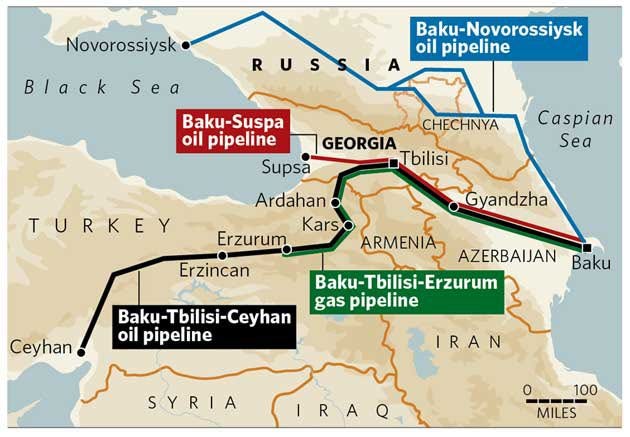
The attack on the Baku Tbilisi Ceyhan pipeline was the clearest sign that the conflict has entered a new phase. That line carries Azerbaijani crude across Georgia to the Turkish Mediterranean coast and supplies a significant share of Israel’s oil. By hitting it, Iran demonstrated that it is willing to expand the battlefield far beyond the Gulf and into the broader network of pipelines and platforms that feed the coalition that targeted it.
This is not a single front. It is a widening perimeter.
A strategy built on controlled escalation
Iran’s actions follow a pattern that resembles a deliberate rationing of global energy stability. The sequence is unmistakable. First came the threats to the Strait of Hormuz. Then came strikes on Gulf infrastructure. Now the campaign has moved into the Caucasus. Each step increases the economic cost for the states involved while avoiding a single overwhelming escalation that would force a decisive Western response.
Tehran is not trying to collapse the global energy system in one blow. It is tightening the pressure gradually, forcing markets to absorb repeated shocks. The goal is to make the cost of continued confrontation unbearable before Washington and its partners run out of targets to strike.
Iran has lived under sanctions for decades. Its economy has already absorbed the worst the global financial system can deliver. The countries now watching their refineries burn and their pipelines go offline have not. Tehran knows exactly how long each of them can endure before political pressure forces a recalibration.
Informational video explaining the massive global fallout if the Strait of Hormuz gets closed.
The Caucasus strike was a message to every energy corridor
The hit on the Baku Tbilisi Ceyhan pipeline was not an isolated act. It was a demonstration of reach. The line is critical for Israel, Turkey, and European markets. Damaging it sends a message that no energy corridor feeding Israel or its partners is beyond Iran’s capabilities.
It also revealed the geographic logic of Tehran’s campaign. Iran is working outward from the Gulf, across the region, into the Caucasus, and toward the Mediterranean. Each strike widens the circle of economic pain. Each strike forces new actors to reconsider the cost of continued confrontation.
The next targets are already visible in the architecture of what remains untouched. The Saudi East West pipeline bypasses Hormuz and is a vital redundancy for global oil flows. Iraq’s offshore loading platforms handle millions of barrels per day and sit within reach of Iranian drones and missiles. The Abqaiq processing hub is the central node of Saudi crude before it reaches any export terminal.
A sequential strike pattern across these assets would overwhelm any strategic petroleum reserve. No emergency stockpile can compensate for simultaneous disruptions across the Gulf, the Caucasus, and the Mediterranean.
The Mediterranean is the next pressure point
The Eastern Mediterranean’s gas fields were once marketed as a stabilizing force for Israel, Cyprus, and parts of Europe. They now sit exposed in a conflict that is expanding outward. Leviathan, Tamar, Karish, Aphrodite, and Glaucus form a cluster of platforms that power Israel’s grid and support European energy diversification. These installations were built for commercial efficiency, not wartime resilience.
Cyprus lacks the air defense systems required to protect its offshore assets. Israel’s defenses are stronger but not designed to shield multiple rigs from a coordinated drone and missile barrage. The result is a set of high value targets that are difficult to defend and easy to disrupt.
A strike on Leviathan or Tamar would cripple Israel’s electricity supply. The country would be forced to fall back on diesel, a fuel that is expensive, polluting, and vulnerable to supply chain interruptions. The economic impact would be immediate. The strategic impact would be profound.
Iran does not need to defeat Israel militarily. It only needs to interrupt the flow of gas.
Europe’s exposure is deeper than it appears
Cyprus is a small state with limited military capacity, yet it plays an outsized role in Europe’s energy plans. Its offshore fields and future export terminals are essential to the EU’s diversification strategy. A strike on Cypriot infrastructure would not only hit Nicosia. It would hit Brussels.
If Iran pairs Mediterranean disruption with pressure in the Strait of Hormuz, the shock would be immediate. Nearly one fifth of the world’s oil passes through that corridor. Even a temporary blockage would send prices soaring. Combined with a hit on Cypriot or Israeli gas, the effect would be global.
Energy markets rely on confidence. A single successful attack on a major offshore platform would shatter it.
The Water Front: Why Desalination Plants Are the Ultimate Pressure Point
Energy is not Israel’s only vulnerability. Water is equally critical. Israel relies on large scale desalination plants for the majority of its drinking water. These facilities are concentrated, exposed, and essential. They are also part of the same infrastructural ecosystem that Iran is now targeting.
A disruption to one of these plants would not simply reduce water output. It would force Israel to ration supplies, divert energy to emergency systems, and activate contingency plans that were never designed for prolonged stress. The political and social consequences would be immediate.
This is why desalination sits at the far end of Iran’s escalation ladder. It is not an early strike. It is a late stage pressure point that magnifies the impact of every other disruption.
Predictive History and the next phase of escalation
Professor Jiang’s Predictive History lectures argue that modern conflicts follow structural patterns rather than political cycles. States behave according to the vulnerabilities built into their infrastructure, not the intentions of their leaders. When systems become overly centralized, overly efficient, or overly interdependent, they create predictable points of failure. Jiang calls these points the historical attractors of conflict. Once pressure begins, events tend to move toward these attractors regardless of diplomacy.
Iran’s current strategy aligns with this model. The Gulf, the Caucasus, the Mediterranean, and the water grid are not separate theaters. They are interconnected systems that share the same structural weakness: concentration. In Jiang’s framework, the next phase of escalation is not determined by ideology but by which node in the network produces the greatest leverage at the lowest cost.
1. Systemic overstrain in the Gulf
Jiang’s first attractor is the moment when a system becomes too stressed to absorb further shocks without cascading failures. The Gulf is approaching that threshold. Iran does not need to destroy infrastructure to trigger systemic overstrain. It only needs to create enough uncertainty that markets begin pricing in permanent instability.
This is the scenario where oil prices rise steadily, not explosively, and where the economic pain accumulates quietly until it becomes politically unsustainable.
2. Infrastructural inversion in the Mediterranean
Jiang’s second attractor is infrastructural inversion. This occurs when the very systems designed to create stability become the primary sources of vulnerability. The Eastern Mediterranean is a textbook example. Israel and Cyprus built their offshore platforms to secure long term energy independence. Those platforms now represent concentrated, undefended assets that can be disrupted at minimal cost.
This scenario forces Europe into the conflict indirectly. A hit on Mediterranean gas is not just an attack on Israel or Cyprus. It is an attack on the EU’s diversification strategy.
3. The water grid enters the irreversible zone
Jiang’s third attractor is the terminal phase of infrastructural conflict, when pressure moves from energy systems to life support systems. Water sits at the center of this phase. Jiang argues that modern states can survive energy shortages, but they cannot survive water stress. When water infrastructure becomes a point of vulnerability, the conflict enters what he calls the irreversible zone. At that point, the political cost of continuing confrontation exceeds the cost of de escalation.
In this scenario, Iran does not need to strike desalination plants directly. It only needs to create enough regional instability that Israel is forced to divert resources, reroute energy, and operate its water grid under emergency conditions. Desalination plants are energy intensive. Any disruption to the electricity supply amplifies water stress. Jiang’s model predicts that once a state begins rationing water, even temporarily, its strategic posture shifts from offensive to defensive.
This is the scenario where Iran’s multi theater pressure campaign converges. Energy, water, and political stability become intertwined. The conflict stops being about territory or deterrence. It becomes a contest over which side can endure systemic stress longer.
Teach these corrupt aggressors a lesson they won’t forget specially Israel and its backers, all the Arab politicians are cowards.
When the dust finally settles, Western leaders will have to defend themselves, not from Iranians but from their own people.
Throw them to the mob!