PUT YOUR SOUL ON YOUR HAND AND WALK (2025)
The Story of Fatma Hassona and the Camera She Used to Challenge Erasure

Most people will come to Put Your Soul on Your Hand and Walk because they know what happened to Palestinian photojournalist Fatma Hassona.
What they discover is a young woman whose life was far greater than the tragedy that eventually claimed it.
Directed by Iranian filmmaker Sepideh Farsi, the documentary follows a series of video conversations between Farsi and Hassona over the course of the Israeli assault on Gaza. Unable to enter the Strip herself, Farsi relied on Fatma to provide a window into a reality that much of the world was either ignoring, misunderstanding or only experiencing through fragmented news reports.
Through those conversations, a portrait gradually emerges.
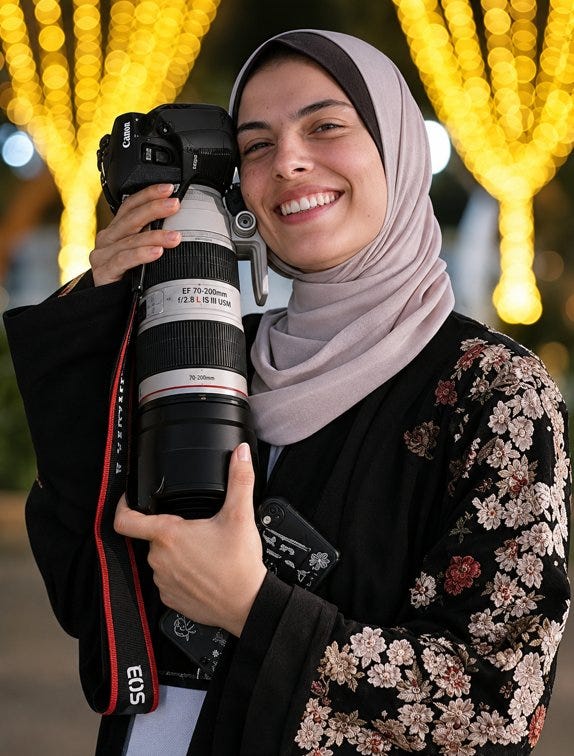
Fatma is a photographer, poet and deeply thoughtful observer of the world around her. She documents destruction because it surrounds her, but her attention is just as often drawn toward the people attempting to survive it. Children playing amongst rubble, families trying to maintain some sense of normality and communities supporting one another despite extraordinary hardship all become part of her visual record.
What makes the documentary so compelling is that Fatma never allows herself to be reduced to a symbol.
The audience sees her discussing photography, sharing stories about her daily life, reflecting on the future and speaking candidly about the limitations imposed on Palestinians living in Gaza. There is frustration, grief and fear, but there is also humour, intelligence and an unwavering attachment to her homeland.
Tip jar is now open if you like our work.
As the film progresses, it becomes increasingly clear that the conversations are documenting more than the destruction of a place.
They are documenting a generation of Palestinians whose lives have unfolded under blockade, military occupation and repeated cycles of violence, yet who continue to insist on their humanity despite relentless efforts to strip it away.
The title of the documentary comes from Fatma's description of venturing outside during bombardment. To leave home under such conditions, she explained, is like carrying your soul in your hands and walking.
It is a phrase that captures the reality of daily life in Gaza more effectively than any political speech or news headline ever could.
One of the most revealing aspects of the film is the contrast between the two women at its centre. Farsi is able to move between countries, attend festivals and continue her work internationally. Fatma, despite her talent and growing recognition as a photographer, remains confined to a territory she cannot freely leave.
Yet there is never any sense that Fatma views herself solely as a victim of circumstance.
She speaks passionately about her work and repeatedly demonstrates a determination to document what is happening around her. She understands the importance of preserving these moments, not simply as evidence of destruction, but as proof that Palestinians lived, loved, created and endured.
The documentary acquired an even deeper significance following the events of April 2025.
On April 15th, Fatma learned that the film had been selected for the ACID programme at the Cannes Film Festival. The following day, an Israeli airstrike struck her family home in Gaza City, killing Fatma and several members of her family.
The devastating timing of her murder by the Israeli terrorists inevitably shapes how audiences experience the documentary. Conversations that might otherwise have been viewed as ordinary suddenly become part of a final testimony.
Yet the film's greatest achievement is that it never allows her death to overshadow her life.
Fatma Hassona emerges not as a passive subject but as the author of her own story. Through her photographs, words and observations, she leaves behind an invaluable record of a period that future generations will struggle to comprehend without witnesses such as her.
Put Your Soul on Your Hand and Walk is ultimately more than a documentary about Gaza. It is a film about memory, documentation and the responsibility to bear witness when the world would often prefer not to look.
Fatma Hassona understood that photographs can preserve what violence attempts to erase.
This documentary ensures that her voice becomes part of that preservation as well.
Fatma Hassona (1999-2025)
Directed by Sepideh Farsi | Palestine, France, Iran | 2025
📍 A Note of Appreciation to the Filmmakers
My sincere gratitude and admiration go to director Sepideh Farsi, Fatma Hassona and everyone involved in bringing Put Your Soul on Your Hand and Walk to audiences around the world.
I would also like to acknowledge the filmmakers, distributors, film festivals and Palestinian solidarity organisations whose efforts have helped ensure that Fatma's photographs, testimony and story continue to reach people beyond the borders that sought to contain them.
Their commitment to preserving and sharing her work is invaluable. At a time when Palestinian lives, histories and experiences are too often reduced to statistics or erased altogether, keeping Fatma's voice alive is an act of remembrance as much as it is an act of documentation.
May her photographs continue to be seen. May her words continue to be heard. And may the courage she displayed in the face of unimaginable circumstances never be forgotten.
This article is shared in appreciation of the documentary and the extraordinary life of Fatma Hassona. All artistic credit, copyrights, intellectual property rights and ownership remain with the filmmakers, producers, distributors and respective rights holders.
I do not claim ownership of the documentary, its images, promotional materials or any copyrighted content associated with the film. This post is intended solely for commentary, education, discussion and to encourage greater awareness of the documentary and its subject matter.
To the filmmakers and rights holders: I share this work with the utmost respect for your efforts and in recognition of the importance of Fatma's testimony. If you have any concerns regarding content referenced in this post, or if you would prefer that any material be amended or removed, please contact me directly and I will address your request promptly and respectfully.
Discussion about this video