


Mainstream media’s favorite question for anyone who dares say they oppose the genocide of the Palestinian people is: “Do you believe Israel has a right to exist as a Jewish state?”
This tired question, like other “gotcha” questions, hopes to spark fear, overwhelming the interviewee’s rational faculties and forcing an incoherent answer to the interviewer’s satisfaction. In this case, the fear is of being labeled antisemitic, an atmosphere Zionists have worked hard to cultivate over decades.
The truth is this question can be handily dismantled either by illuminating the faults of its premises, or in playing their game and responding with facts and logic. More than that, it can be used as an opportunity to shift the conversation to human rights, exposing what this question is really meant to do: shield a genocidal regime from criticism, set the boundaries to critical thought about the issue, and defend the indefensible by blaming the victim.
While the fabricated concept of Israel’s “right to exist” has blocked peace negotiations for years, seen great success in equating Anti-Zionism to antisemitism, and almost single-handedly kept single-state solution discourse from the mainstream, it doesn’t have to continue. What has been an effective tool for Zionists can be turned into an effective tool for Anti-Zionists. This article outlines a starter toolkit for doing just that.
Dismantling the Premises
“What Do You Mean by Jewish State?”
Zionism was founded as a secular nationalist movement in response to 19th century European antisemitism. Theodor Herzl, its founder, was atheist and considered land in East Africa and Argentina for the Jewish state. Palestine was ultimately chosen due to being the ancient Jewish homeland, an alluring factor the others couldn’t compete with. Despite its secular birth, as Zionism grew it gained other factions, including significant influence from the religious Mizrachi movement.
History demonstrates that while Zionists want a “Jewish state” in historic Palestine, there isn’t a neat definition for it. Further, once you start exploring how to define it, the answers reveal the deeply immoral foundation of the whole project of Zionism. When asked if Israel has a right to exist as a Jewish state, Michigan senate candidate Abdul El-Sayed simply responded “What do you mean by Jewish State?”, which stopped the interviewer in her tracks.
There are three ways you could interpret the “Jewish” component of a Jewish state: (1) by faith, (2) by power, or (3) by majority. If by faith, it means a theocracy, in direct opposition of Western values like freedom of religion and separation of church and state. If by power, democracy cannot exist and inequality is institutionalized. The requirement for power to be held by one group necessitates supremacy of one group over another. This is the apartheid system that exists today.
If by majority, unethical and destructive practices are required. Zionist leaders knew from the outset that the demographics of Palestine required ethnic cleansing and massive Jewish immigration: ‘Our thought is that the colonisation of Palestine has to go in two directions: Jewish settlement in Eretz Israel and the resettlement of the Arabs of Eretz Israel in areas outside the country.’ - Zionist leader Leo Motzkin. In fact, when the Balfour Declaration was established in 1917, making British support for Zionism official, Jews made up just 6% of the population of Palestine. Requiring a certain demographic makeup of a country is inherently unsustainable and oppressive, particularly if the dominant group started off as a small minority.
Ultimately, whichever way you define the Jewish state in regards to Israel, it is highly problematic. The question hopes you will unknowingly condone ethnic cleansing or the existence of theocracies or ethnostates while yourself living in a country (if you’re in a republic) whose constitution explicitly condemns them. El-Sayed explains it best:
States Don’t Have Rights, People Do
First things first, rights are for people, not states. Rights are a humanmade concept meant to protect human freedom and dignity. They are not for states, which are institutional arrangements created by groups of people, not people. A state’s “right to exist” is not recognized in international law, period.
The “right to exist” is a rhetorical fabrication meant to prevent Palestinian statehood. States establish themselves through force. The international system then accepts their participation if they meet the obligations of states. There is, however, no legitimacy given to the right of their existence. Despite this, the US and Israel have used this rhetorical trap to prevent formal negotiations with Palestinian political leadership – the Palestinian Liberation Organization (PLO) from 1975 to 1993, and Hamas from 2006 to the present. Noam Chomsky in a 2005 interview described this strategy:
“And that’s what mainstream opinion is: Israel should have what’s called the abstract “right to exist.” No state has a right to exist, and no one demands such a right. For example, the United States has no such right. Mexico doesn’t respect the right of the United States to exist, sitting on half of Mexico, which was conquered in war. They do grant the U.S. rights in the international system, but not the legitimacy of those rights.
This concept “right to exist” was in fact invented, as far as I can tell, in the 1970s when there was general international agreement, including the Arab states and the PLO, that Israel should have the rights of every state in the international system. And therefore, in an effort to prevent negotiations and a diplomatic settlement, the U.S. and Israel insisted on raising the barrier to something that nobody’s going to accept. Certainly, the Palestinians can’t accept it. They’re not going to accept Israel’s existence but also the legitimacy of its existence and the legitimacy of their dispossession. Why should they accept that? Why should anyone accept it?”
The closest thing to rights relating to states is the right of peoples to self-determination, a right enshrined in the first article of the UN charter. Ironically, this is a right that the Palestinian people have, which Israel’s existence has been violating for almost 80 years.
Francesca Albanese, UN Special Rapporteur on the Occupied Palestinian Territories, describes this tragic and unforgivable irony in her response to the question:
“What is enshrined in international law is the right of a people to exist. The state is there, it’s protected as a member of the UN. Does this justify the erasure of another people? Hell no. Not 75 years ago, not 57 years ago, surely not today. Where is the protection of the Palestinian people from erasure, from annexation, from illegal occupation and apartheid? This is what we need to discuss”.
Historical and Logical Reasons
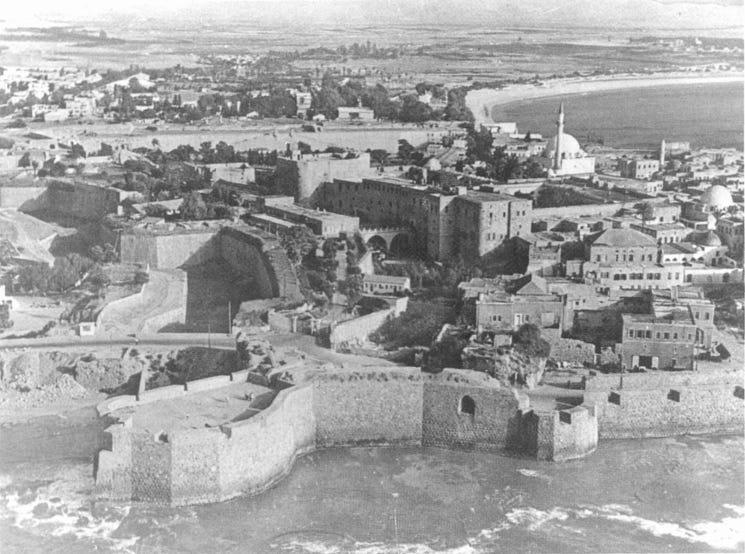
‘Amqa (“Acre”), pre-1948 Palestinian village. Khalidi, Walid. All That Remains: The Palestinian Villages Occupied and Depopulated by Israel in 1948 (p. 48)
“A Land Without a People For a People Without a Land”
Israel’s “right to exist” is partly grounded in the argument that the Jewish people have the right to self-determination. That idea itself is fine. It was where they wanted to create a state that was a problem. Zionism wanted “a land without a people for a people without a land”, but Palestine was fully inhabited by a long-standing people with a rich culture and civilization. As such, it was a settler-colonial project.
Some early Zionists, like Ze’ev Jabotinsky, advocated for a strong military to force Arab acceptance of a new Jewish majority. Others, like Israel’s first prime minister David Ben-Gurion, advocated for forced removal of the Palestinian Arabs. Of course they all knew the Palestinians were there, there was no denying that. However, the early Zionist framing of “a land without a people” attempted to morally justify their violence, and the spirit of the phrase has supported Israeli distortions of international law and dehumanization of Palestinians, seen today in members of the Israeli government like Bezalel Smotrich who says “there’s no such thing as a Palestinian people”.
Ethnic cleansing was in fact carried out during the 1948 Arab-Israeli war, where 750,000 Palestinians (around 80% of the Arab population of Israel) were expelled in what is called the Nakba (catastrophe). After the war, Israel deliberately destroyed and renamed previous Palestinian villages, hoping to erase them from memory and prevent the Palestinians’ right of return. In his book “All That Remains: The Palestinian Villages Occupied and Depopulated by Israel in 1948”, Palestinian historian Walid Khalidi exposed the “land without a people” lie at the heart of the Zionist project:
“Thus the dispossession of the Palestinian village population of 1948 did not involve a transient or migratory population, but an ancient indigenous farmer community as settled as any in the Mediterranean basin or indeed anywhere else. While pre-industrial, the villagers belonged to a civilization that had enriched the human heritage with its contributions in the fields of religion, literature, philosophy, architecture, and the sciences. They were no less rooted in their patrimony and communal associations than any other people anywhere.”
The right to self-determination does not give a people a right to create a settler colony and forcibly displace indigenous people. One people’s right to self-determination does not trump another’s, especially in the latter’s land. The only ethical system you could ground that in is “might makes right”.
(Il)logic of the Religious Claim
This one goes without saying, but is worth a mention due to the rise of the religious right in Israel. The foundational claim of religious Zionism is that God gave the land of ancient Israel to the Jews in a biblical covenant: “To your descendants I have given this land,” Genesis 15:18. Additionally, the return to the land is the “beginning of redemption,” a visible unfolding of messianic prophecy. This is obviously problematic reasoning because the world does not accept ancient religious texts as a justification to conduct ethnic cleansing and create settler colonies.
Truth About the Indigenous Claim
The core Zionist argument around indigeneity is that Jewish peoplehood, religion, language, and cultural practice originated in the land around 3000 years ago. While this is true, the problem with the argument is that Jews stopped being the majority in the 400s. Does an ancient tie to the land give anyone a right to impose a Jewish state almost 2000 years later? We are all descendent from Africa originally, everybody is diasporic. Ancient migration and history is not a legitimate reason to impose ethnic cleansing and occupation.
Additionally, Palestinians have higher genetic continuity to ancient Levantine populations than Ashkenazi Jews (who made up 80% of the Jewish population at Israel’s founding), largely because Ashkenazi Jews had significant mixing with European populations during the Jewish diaspora. The Palestinians stayed on the land over millennia, many of them converting to Christianity from Judaism during the Byzantine Empire then to Islam in the 600s (their “Arab” identity today stems from cultural assimilation, not genetic replacement).
To put it more bluntly, here’s Jeff Halper, an Israeli anthropologist:
“Every settler movement makes up a narrative about why the country belongs to them. I mean, how can a Jew come from Ukraine to Palestine and say this country is mine, and you Palestinians have no place here… You can’t. If you didn’t have a story to tell, you’d just be a criminal. You’d be some guy coming in and stealing somebody else’s land. ‘Well I don’t want to be that’. So to justify what you’re doing, you come up with a whole narrative. God gave us this land, this is ancient Israel, we were driven out by the Romans and now we’re coming back…”
Problems With Partition
The “right” to exist must be grounded in something, as the concept is a human creation. One might argue that the 1947 UN Partition Plan for Palestine enshrines that right in international law. However, there are several reasons that doesn’t work:
Claiming an international body can provide legitimacy to a colonial project, displacing indigenous people from their land, is absurd. In fact, the UN plan violated a fundamental principle of the UN charter: the right of a people to self-determination. This hypocrisy is why the Arab states boycotted the process, as “Palestine Arabs natural rights are self evident and cannot continue to be subject to investigation but deserve to be recognized on the basis of principles of United Nations charter ends.” The boycott instructed all Arabs not to engage with the UN special committee on Palestine (UNSCOP). As a result, the committee’s work was only informed by visits to Zionist Jews, not Palestinian Arabs.
Besides lacking participation and perspective of the Palestinian Arab side, which severely undercut the legitimacy of the work they were doing, the UN investigation was riddled with biases, interference, and bribery/collusion. The Zionist militia Haganah (today’s IDF) conducted extensive spying and interference with committee activities, for instance replacing the cleaning staff of the building where hearings took place with intelligence agents.
The Israel lobby was in full force in the US during the 1940s and much of the domestic political establishment was tied to Zionist organizations. Despite President Truman’s role in pushing the vote through, he was open about the collusion that occurred:
“The facts were that not only were there pressure movements around the United Nations unlike anything that had been seen there before, but that the White House, too, was subjected to a constant barrage. I do not think I ever had as much pressure and propaganda aimed at the White House as I had in this instance. The persistence of a few of the extreme Zionist leaders—actuated by political motives and engaging in political threats—disturbed and annoyed me.”
The UN partition plan itself was outrageous. It recommended partitioning 56% of Palestine to the Jewish state, including the most fertile land, at a time when Jews encompassed 33% of the population and owned less than 7% of the land. Nearly half a million Arabs would remain in the Jewish state. In short, the UN proposal was for a Jewish state with 45% of the population, the “minority”, not even Jewish.
If the UN partition plan itself was ridiculous, the reality was much worse than it. The plan itself was never implemented due to the outbreak of the Arab-Israeli war of 1948. After the war, Israel prevented refugees of the Nakba from returning and controlled 78% of Palestine. A negotiated truce set armistice lines, later known as the “Green Line”, which became the internationally recognized border. That was the least amount of land Israel has ever held, with various encroachments over time leading to control of 90+% today on top of the Golan Heights stolen from Syria.
Post-Partition Violations of International Law
Putting aside the dialectics of how power relates to law, if international law is used as a justification for a “right” to exist, then a respect for international law must be maintained. Also, respect for international institutions must be maintained. This has clearly not been the case.
Israel, since its inception, has consistently violated international law. A shortlist of violations includes:
The UN charter, prohibiting the use of force without a prior armed attack occurring and land acquisition and annexation by force.
The International Court of Justice (ICJ) case of the Application of the Genocide Convention in the Gaza Strip (South Africa v. Israel), prohibiting prolonged occupation of land, apartheid, and genocide.
Geneva Conventions IV, prohibiting settlements on occupied land, ethnic cleansing, collective punishment, and preventing the right of return of civilians following the end of armed conflict.
The Rome Statute (International Criminal Court (ICC)), prohibiting apartheid. The ICC also has active arrest warrants out for Israeli Prime Minister Benjamin Netanyahu and Defense Minister Yoav Gallant for war crimes and crimes against humanity, specifically the use of starvation as a weapon, intentionally directing attacks against civilians, and restricting humanitarian aid.
Besides these violations, Israel has also violated dozens of UN security council resolutions, which are binding for member states, and continuously committed human rights abuses like forcible transfer, torture, sexual violence, unlawful killings, targeted assassinations, house demolitions, and much more, widely documented by human rights organizations. Israel is also currently in violation of ICJ court orders since the early months of 2024 and not only avoiding the ICC arrest warrants but working with the US to try to undermine the legitimacy of the court.
If using international bodies as justification for their right to exist, they can’t only point to a partition resolution that was hugely problematic and not ever even applied, then proceed to violate every international law and norm under the sun, while trying to sanction and destroy international courts. Israel’s record with international law is not only horrific and heartbreaking, but clearly shows the hypocrisy of using international law as a justification for its right to exist.
Toward Decolonization
Armed with the truth, you can turn the supposed “gotcha” question into an opportunity to dismantle the legitimacy of the question and its premises. No state has a “right to exist” and a Jewish state in a land where the population was less than 10% Jewish to begin with is unethical no matter how you look at it.
It is obvious to anyone paying attention that Israel, as the supremacist, terrorist state it is, cannot continue. The Israeli public overwhelmingly supports the country’s atrocities. Israeli historian Ilan Pappe has described how children are systematically indoctrinated in school to be racist towards Arabs. The country has descended into outright fascism, yet Zionism’s attempt to swallow Judaism and weaponize the memory of the Holocaust has been so successful that we have trouble seeing the oppressor for what it is: a genocidal, settler-colonial apartheid state. We don’t need to be shy about discussing the need to dismantle the Zionist entity.
Putting aside whether a two-state solution was ever intended, there are fundamental reasons it is an all-around bad idea and infeasible: (1) native populations will never accept their own dispossession and the violation of their rights, (2) settler-colonial projects are built on racism and a thirst for expansion, and (3) Palestine was never a homogenous place. The Palestinian scholar Edward Said articulated this oft-neglected truth in his 1999 article “One-State Solution”:
“First, Palestine is and has always been a land of many histories; it is a radical simplification to think of it as principally or exclusively Jewish or Arab. While the Jewish presence is longstanding, it is by no means the main one. Other tenants have included Canaanites, Moabites, Jebusites and Philistines in ancient times, and Romans, Ottomans, Byzantines and Crusaders in the modern ages. Palestine is multicultural, multiethnic, multireligious. There is as little historical justification for homogeneity as there is for notions of national or ethnic and religious purity today.”
The Palestinian people need to finally be given their right to self-determination in their land, as the UN charter was meant to protect. Jews and Arabs need to live together in peace in a true democracy. That is the only way forward. Said takes us through this reasoning as well as highlighting our responsibility:
“Once we grant that Palestinians and Israelis are there to stay, then the decent conclusion has to be the need for peaceful coexistence and genuine reconciliation. Real self-determination. Unfortunately, injustice and belligerence don’t diminish by themselves: they have to be attacked by all concerned.”
It may be hard for the average person to imagine contributing to the political effort, but we can help in small ways by dismantling the rhetoric of Israel’s “right to exist”, bringing a single state into the conversation. While Palestinians need international support in all manners of resistance, abolishing the Zionist state and materializing a single decolonized state is a critical responsibility of the international community. Dismantling of South African apartheid wouldn’t have been possible without international sanctions. The subjugated population does not have the means to do it on their own, and will be labeled terrorists and punished harshly for suggesting Israel should be dismantled.
Public opinion is changing. A recent poll shows almost half of young American Jews want a single state solution. Ilan Pappe has been consistently speaking on the need for decolonization, while highlighting the cracks in Israel’s foundation, growing international solidarity with Palestine, and how we are in a moment of great potential. The Palestinians have been suffering a horrible tragedy and paying the price of European antisemitism for far too long. We must meet the moment and fight for an end to the genocide as soon as possible, with decolonization to follow. The heart of our responsibility is best described by Pappe’s words at the end of a recent talk at the Second Annual Jewish Anti-Zionist Congress:
“Decolonize Palestine, de-Zionize it, liberate it, but more than anything else, make it a normal human place—something the Zionist project wrote the Palestinians out of for the last 120 years.”
A few years ago I posted something about the genocide on my Instagram story and someone I knew from high school asked me this question. At the time, I knew none of this and answered "yes". Actually looking into it, it's sad how much power this pathetic question has had. I hope more and more people begin to look into it and discover the tragic but simple truth.
80 years of illegal occupation, 25 officially recorded massacres dating back to the pre 1948 Nakba, countless human rights violations & atrocities et al !! All of the above & the world doesn’t know the half of it. This, after the Palestinians not only welcomed the Zios (in disguise) to thier land but showed empathy & all they got for thier infinite generosity was 8 decades of genocide !!
So unequivocally NO any contrived state of the Satanic persuasion has any right to exist !! 🇵🇸🧕🇱🇧