


With American warplanes striking Iranian nuclear sites and Tehran’s leaders firing back across the Persian Gulf, the present moment represents a generational low in relations between two nations that were once the closest of allies. “The bad blood isn’t new,” observes Jeffrey Fields of USC. “The U.S. and Iran have been in conflict for decades – at least since the U.S. helped overthrow a democracy-minded prime minister, Mohammed Mossadegh, in August 1953.” For Iranians, however, the story of betrayal begins earlier and cuts deeper: a narrative of oil, empire, and repeated violations of sovereignty that stretches from the end of World War II to the present day.
Prelude: The Geopolitical Chessboard (1941–1951)
The end of World War II transformed Iran from a distant curiosity into a vital prize in the emerging Cold War. The country’s vast oil reserves had made it, in the words of one analysis, “a pawn in a global chess game” by 1949, with the great powers “circling like vultures, each craving control”. Britain had established a dominant presence through the Anglo-Iranian Oil Company (AIOC), which extracted Iranian oil on terms so unfavourable that the Iranian government received only a fraction of the profits. The United States, initially content to operate through missionary contacts, oil companies, and local diplomats, was drawn into deeper involvement by the war itself, which brought about what one historian calls “a more concrete American involvement in the country’s politics”.
The early post-war years saw the first fateful American policy choices. Washington’s stated concern was containing Soviet penetration—Moscow had attempted to establish a puppet regime in Iranian Azerbaijan during the war—but the deeper logic was energy security. The Truman administration’s 1946 intervention against Soviet designs placed the United States firmly on the side of the Iranian monarchy, setting the stage for what would become a 37-year alliance with the Pahlavi dynasty.
The Original Sin: The 1953 Coup
If there is a single event that defines the Iranian understanding of American betrayal, it is the coup of August 1953. In 1951, the Iranian parliament had chosen Mohammad Mossadegh as prime minister, and the new leader promptly did the unthinkable: he nationalised the British-controlled oil industry. The act was wildly popular among Iranians who saw it as the reclamation of their country’s most valuable resource. For Britain and the United States, however, it was intolerable.
Operation Ajax—the joint CIA-MI6 covert operation—was conceived as the remedy. Funded by the American and British governments, the operation deployed CIA-funded agents to “foment unrest inside Iran by way of the harassment of religious and political leaders and a media disinformation campaign”. The CIA’s own operative, Kermit Roosevelt, grandson of Theodore Roosevelt, “bribed key people and launched a smear campaign against Mosaddegh, who was staunchly anti-communist”, yet was successfully vilified in the Western press as a communist fellow traveller.
The coup nearly failed. The shah, young and terrified, vacillated over signing the royal decrees that the CIA had prepared. Fighting between supporters of both sides left some 300 people dead in the streets of Tehran. But on August 19, Mossadegh was arrested, tried, and kept under house arrest until his death 14 years later. In his place, the West reinstalled Mohammad Reza Shah Pahlavi—a pro-Western monarch who would serve as Washington’s most reliable client in the Middle East for the next quarter-century.
The consequences were immediate and lasting. Post-coup, seven American oil companies known as the ‘Seven Sisters’—including Exxon and Mobil—took over the oil operations that Britain had previously controlled. The Shah, nominally sovereign, “never got even half the profits”. For Iranians, the message was clear and has never been forgotten: “Washington called it ‘necessary’. Iranians called it betrayal.” In 2013, after decades of denial, the CIA finally admitted its role in the overthrow.
The Shah’s Reign: A Propped-Up Dictatorship (1953–1979)
For more than a quarter-century after the coup, the United States provided virtually unfettered support to one of the Middle East’s most repressive regimes. The Shah proved “deeply unpopular among his people for his autocratic rule,” yet American presidents fawned over him. In 1972, President Richard Nixon appeared beside the Shah in an open-top limousine before cheering crowds in Tehran, a carefully choreographed tableau of the alliance.
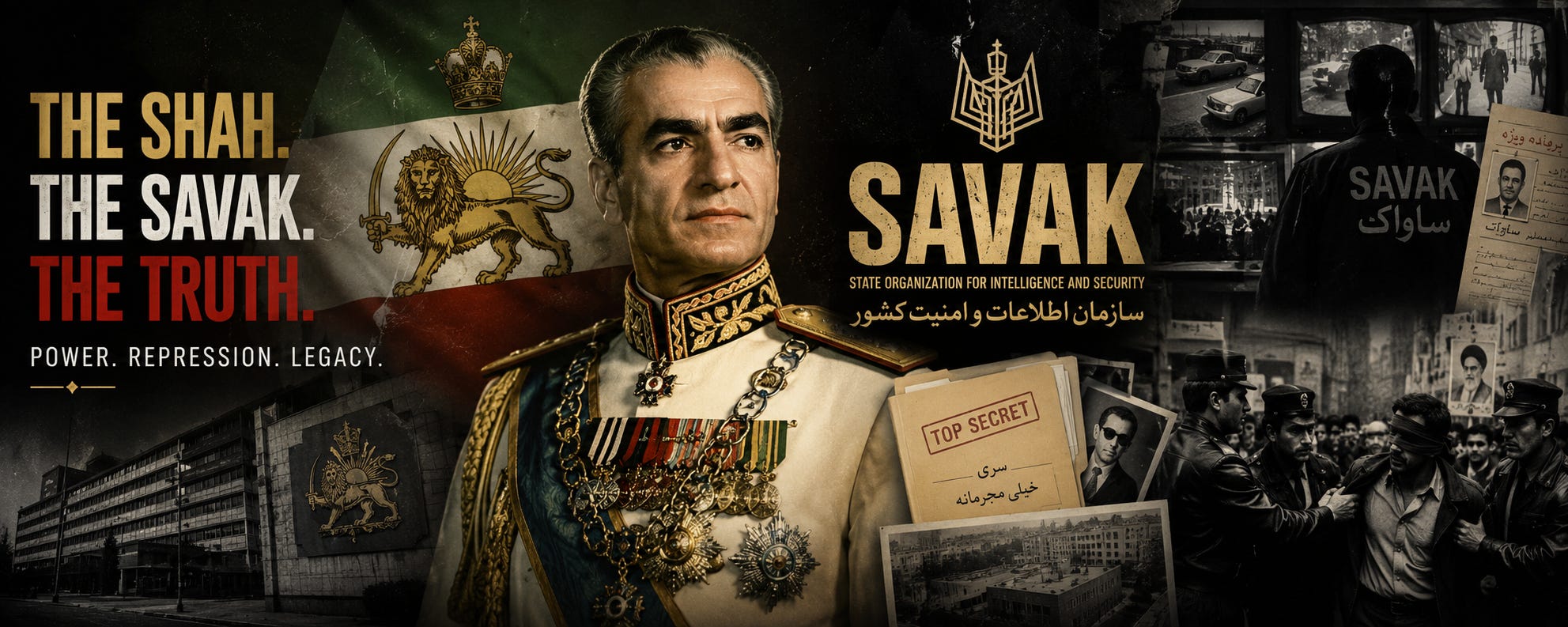
Behind the pageantry lay a machinery of state violence. With American encouragement and assistance, the Shah established SAVAK, his feared secret police force, in 1957. The United States “proposed that Mohammad Reza Shah’s regime establish SAVAK, despite being aware of the regime’s crimes against the Iranian people”, according to an Iranian court indictment, and “held training sessions for SAVAK members” in interrogation and surveillance techniques. American advisors “supported Savak, the dreaded secret police responsible for the torture and brutal deaths of untold numbers of Iranian citizens”. While the Iranian regime’s own documents must be read with the scepticism appropriate to any government’s self-serving narratives, the broad outlines of U.S. complicity in the Shah’s machinery of repression are corroborated by declassified American records and independent historical scholarship.
The United States also laid the foundations for what would become one of its most intractable policy challenges: Iran’s nuclear programme. Under Eisenhower’s “Atoms for Peace” initiative, the United States supplied Iran with its first nuclear reactor—the Tehran Research Reactor—in 1959, along with weapons-grade 93% enriched uranium fuel. American scientists trained Iranian nuclear experts at elite institutions like MIT, and Washington encouraged partnerships with European allies. “We gave Iran its starter kit,” said Robert Einhorn, a former U.S. arms control negotiator. “We weren’t terribly concerned about nuclear proliferation in those days, so we were pretty promiscuous about transferring nuclear technology.”
By the 1970s, the Shah’s nuclear ambitions had scaled dramatically. Despite sitting on the world’s third-largest oil reserves, Iran was determined to become a nuclear power “in both symbolism and capability”. France and Germany signed multibillion-dollar reactor deals. The Shah announced plans to procure eight nuclear power plants from the United States alone. In 1974, asked whether Iran would one day possess a nuclear weapon like India, the Shah famously declared, “Without any doubt, and sooner than one would think.”
The Shah’s Iran became the largest purchaser of American weaponry and aircraft in the developing world, fuelling an arms race that enriched U.S. defence contractors while steadily alienating the Iranian population. The contradiction at the heart of American policy—championing democracy in rhetoric while bankrolling autocracy in practice—would have explosive consequences.
The Revolution and the Hostage Crisis (1979–1981)
When the Islamic Revolution erupted in 1979, the United States was caught flat-footed. The Shah, Washington’s man for a quarter-century, fled the country in January, and Ayatollah Ruhollah Khomeini returned from exile to establish a Shia theocracy. The upheaval severed the U.S.-Iran alliance overnight, and the mutual recriminations began immediately.
In November 1979, fundamentalist students seized the U.S. Embassy in Tehran, taking 52 Americans hostage. The crisis would last 444 days, humiliate the Carter administration, and embed a perception in the American mind of Iran as a rogue state that violated the most basic norms of international conduct. “Iran’s refusal to follow diplomatic protocol cemented the US perception of it as a rogue state.” At the same time, Iran’s “bad relationship began further back, in 1953, when the CIA engineered a coup” to destroy Iranian democracy.
The hostage crisis produced multiple layers of betrayal. For the United States, it was the spectacle of diplomats held captive by a revolutionary regime that flouted its obligations under international law. For Iran, it was the discovery that the United States had repeatedly acted outside international law itself—most starkly in 1953—and was now demanding respect for norms it had never honoured. The crisis set the tone for the ensuing decades, “each marked by a cycle of confrontation”.
The formal rupture was complete. The United States severed diplomatic relations in 1980, seized Iranian assets, and banned most trade. A disastrous rescue mission ordered by President Carter failed in the Iranian desert, leaving eight American servicemen dead. The hostages were finally freed on January 20, 1981, minutes after Carter left office and Ronald Reagan was inaugurated. The symbolism was unmistakable: Iran had waited until the last possible moment to humiliate the president who had presided over America’s impotence.
The Iran-Iraq War: Arming Saddam (1980–1988)
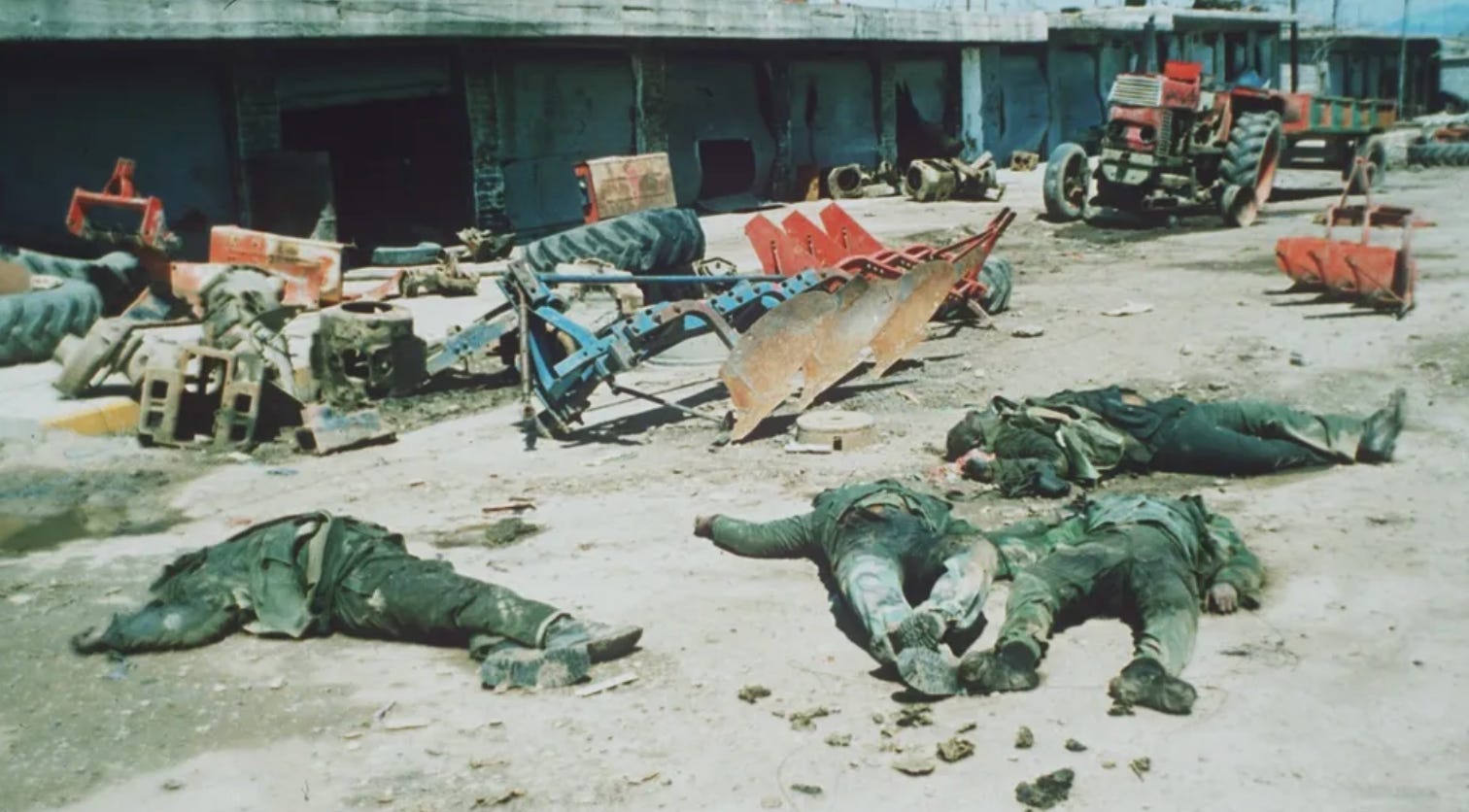
If the 1953 coup was the original sin, the Iran-Iraq War was perhaps the most cynical chapter in the American betrayal narrative. In September 1980, Saddam Hussein’s Iraq invaded Iran, launching an eight-year conflict that would kill at least half a million people and become the Middle East’s bloodiest modern war. The United States was officially neutral—and in practice tilted decisively toward Baghdad.
Washington provided Iraq with intelligence, economic aid, and military support. The Reagan administration removed Iraq from its list of state sponsors of terrorism in 1982, opening the door to more direct assistance. According to multiple accounts, the United States supplied Iraq with satellite intelligence on Iranian troop movements. These extended agricultural credits freed up Iraqi funds for weapons purchases and facilitated the transfer of dual-use technologies with military applications.
Most damning of all, the United States looked the other way as Iraq deployed chemical weapons against Iranian soldiers and civilians. “When Saddam’s forces gassed Iranian cities—Ahvaz, Abadan, Khorramshahr, Mehran, and Sardasht—the US turned a blind eye and provided diplomatic cover for war crimes.” The Reagan administration’s response to the chemical attacks on Iranian targets was notably muted compared to its later outrage over Saddam’s 1988 gassing of Iraqi Kurds at Halabja—an atrocity the United States initially tried to blame on Iran.
The cynical calculation was transparent: an Iranian victory would be catastrophic for American interests, while a stalemate bleeding both nations served Washington’s purposes. The war dragged on for eight years, devastating Iran’s economy, killing hundreds of thousands of young Iranians, and embedding a deep conviction in the national psyche that the United States was not merely a rival but an active enemy willing to countenance any horror to destroy the Islamic Republic.
“Mistakenly”: The Shootdown of Iran Air Flight 655 (1988)
On July 3, 1988, in the closing months of the Iran-Iraq War, the USS Vincennes—a U.S. Navy guided-missile cruiser—was operating in Iranian territorial waters in the Persian Gulf when it fired two surface-to-air missiles at Iran Air Flight 655, a scheduled civilian passenger flight from Tehran to Dubai. The Airbus A300 was flying its usual route within Iranian airspace, having just taken off from Bandar Abbas. All 290 people on board were killed, including 66 children and 38 non-Iranian citizens from Pakistan, the United Arab Emirates, India, Yugoslavia, and Italy.
The United States government’s response was immediate and unapologetic. The Navy claimed the Vincennes had misidentified the civilian airliner as an attacking F-14 fighter jet—an explanation that was contradicted by the aircraft’s commercial transponder signals, its climbing trajectory consistent with a departing airliner, and the fact that it was broadcasting on civilian air-traffic control frequencies. An internal U.S. Navy investigation largely exonerated the ship’s crew, awarding commendations to officers involved in the incident.
The United States has never formally apologised for the shootdown. In 1996, the U.S. government agreed to pay $61.8 million in compensation to the victims’ families—but explicitly stated that this was an ex gratia payment, not an admission of legal liability. To this day, the shootdown remains a raw wound in Iranian national memory, commemorated annually and cited as proof of American contempt for Iranian lives.
A Hand Extended: The Post-9/11 Opening and the “Axis of Evil” Betrayal (2001–2002)
In the immediate aftermath of the September 11, 2001, attacks, Iran did something that seemed unthinkable after two decades of enmity: it offered to help the United States. Across Iran, people held spontaneous candlelight vigils for the American victims—the only pro-U.S. demonstrations in the Middle East. In the government of reformist President Mohammad Khatami, there was a swift official condemnation of the attacks and a strategic calculation that the moment could break the cycle of hostility. The enemy of their enemy was now the Taliban, the radical Sunni regime in Afghanistan that had murdered nine Iranian diplomats in Mazar-i-Sharif in 1998 and had brought the two countries to the brink of war.
Behind the scenes, Iranian and American diplomats met regularly in Geneva under the aegis of the United Nations “Six-Plus-Two” talks on Afghanistan. The cooperation deepened at the December 2001 Bonn Conference, which was tasked with forming a post-Taliban government. According to James Dobbins, the U.S. special envoy to Afghanistan, Iran played a decisive and constructive role. When negotiations deadlocked over the composition of the new Afghan interim government, it was the Iranian envoy, Javad Zarif, who helped break the impasse, persuading the Northern Alliance’s recalcitrant leader, Yunus Qanooni, to accept a broad-based administration led by Hamid Karzai. “Without the Iranians we would not have been able to get the Bonn agreement,” a senior U.S. official privately conceded at the time. Iran further shared intelligence on Taliban targets, offered to allow U.S. search-and-rescue missions on its territory, and detained fleeing al-Qaeda members, proposing to exchange information on them.
For a brief window—no more than a few months—the architecture of a pragmatic, even cooperative U.S.-Iran relationship seemed almost tangible. Genuine back-channel discussions explored the possibility of a “grand bargain”, a comprehensive normalisation that would address nuclear issues, Iran’s support for Hezbollah, and the lifting of sanctions.
President George W. Bush’s State of the Union address on January 29, 2002, annihilated that possibility. In a single sentence, Bush grouped Iran with Saddam Hussein’s Iraq and Kim Jong-il’s North Korea as an “axis of evil, arming to threaten the peace of the world”. The designation was not merely rhetorical; it signalled that the administration had chosen the path of regime change over engagement. Iranian reformists, who had placed their political capital on the line to build bridges with Washington, were devastated and humiliated. Iranian hardliners, who had always argued that the United States could never be trusted, were vindicated overnight. The cooperation on Afghanistan collapsed, the al-Qaeda intelligence channel froze, and the detention of terror suspects in Iran turned into a standoff rather than an exchange.
For Iranians, the “Axis of Evil” speech completed a textbook betrayal narrative that ran from 1953 through 1988: extend a hand, and Washington will slap it away. The moment poisoned the well just as the nuclear issue was beginning to dominate the bilateral agenda, pushing Iran’s decision-making into the shadows where a covert enrichment programme would later be exposed. As Dobbins later reflected, “It may be that we will never know whether a genuine strategic opening with Iran existed, because we never tried it seriously.” But for Tehran, the lesson was indelible. The United States did not want a partner; it wanted a vassal state, and when it could not have one, it preferred an enemy to justify its regional posture.
Nuclear Double-Bind (1990s–2015)
The irony of the nuclear confrontation that has dominated U.S.-Iran relations for the past quarter-century is that the programme was born of an American gift. The Tehran Research Reactor, the training at MIT, and the Atoms for Peace initiative—all were provided by the United States to a regime it considered a reliable ally. When the Islamic Republic inherited this nuclear infrastructure, it also inherited the American conviction that Iran could not be trusted with the technology.
The post-revolutionary nuclear story is one of hypocrisy on both sides. The United States, which had cheerfully supplied nuclear technology to the Shah, now led international efforts to deny the same technology to the Islamic Republic—while continuing to maintain its own vast arsenal and that of its close ally Israel. Iran, for its part, pursued enrichment activities in secret while insisting its program was entirely peaceful, a pattern of deception that the IAEA repeatedly criticised.
The Joint Comprehensive Plan of Action (JCPOA), negotiated by the Obama administration and signed in 2015, represented the most serious attempt to resolve the impasse. Iran agreed to dramatic limits on its enrichment activities and to an intrusive inspections regime in exchange for sanctions relief. For a brief moment, a different trajectory seemed possible.
The 2018 Withdrawal and “Maximum Pressure”
That possibility was foreclosed when President Donald Trump unilaterally withdrew the United States from the JCPOA in May 2018 and reimposed crippling economic sanctions. The withdrawal came despite Iran’s verified compliance with the agreement’s terms, confirmed repeatedly by IAEA inspectors. For Iranians, the withdrawal confirmed everything they believed about American bad faith: the United States could not be trusted to keep its word, and any agreement could be shredded by the next occupant of the White House.
The reimposition of sanctions devastated the Iranian economy. Oil sales plummeted, inflation soared, and ordinary Iranians bore the brunt of the suffering while the regime remained in power. In April 2019, the United States took the unprecedented step of designating the Islamic Revolutionary Guard Corps (IRGC)—an official branch of Iran’s armed forces—as a foreign terrorist organisation. The designation was more than symbolic; it made any interaction with IRGC personnel a potential act of material support for terrorism, closing off one of the last remaining channels of informal communication between the two militaries.
The Assassination of Qasem Soleimani (2020)
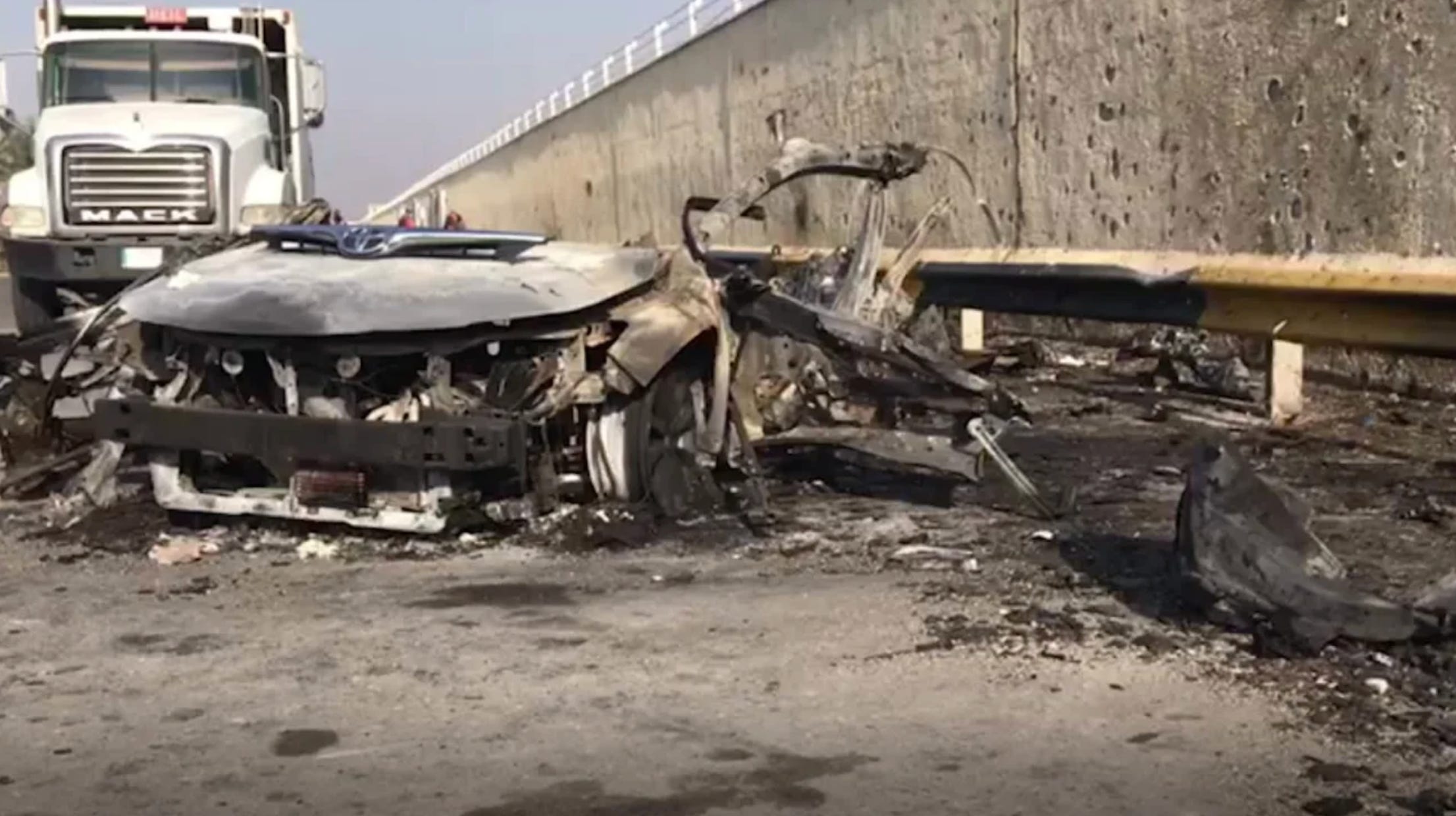
Then came the killing. On January 3, 2020, an American drone fired a missile at a convoy leaving Baghdad International Airport, killing Major General Qasem Soleimani, commander of the IRGC’s elite Quds Force, along with Abu Mahdi al-Muhandis, deputy head of Iraq’s Popular Mobilisation Units. Soleimani was in Iraq on an official diplomatic mission at the invitation of the Iraqi government.
The Trump administration justified the strike as a defensive action to disrupt an “imminent attack” on Americans—a claim that has been fiercely contested by legal scholars and that the administration declined to fully substantiate to Congress. From Iran’s perspective, the killing was something else entirely: “a blatant violation of international law” and a “cowardly act of terrorism” that constituted state-sponsored assassination of a senior official of a sovereign state.
The legal analysis is damning. The targeted killing of a foreign military leader of a state with which the United States was not at war violated the UN Charter’s prohibition on the use of force, breached Iraqi sovereignty, and contravened the customary international law prohibition on assassination. As the Iranian ambassador to the United Nations argued, “this deliberate and unlawful targeting of a senior official of a sovereign Member State of the United Nations… constitutes a flagrant violation of international law.”
For Iranians, the Soleimani killing was a crystallising moment: the United States had been violating international law since 1953; now it was doing so openly, without apology, and with the explicit authorisation of the American president. The assassination triggered a vote by the Iraqi Council of Representatives calling for the expulsion of all U.S. forces from Iraqi territory.
Iran retaliated with ballistic missile strikes on U.S. bases in Iraq—and then, in a bitter postscript, accidentally shot down Ukraine International Airlines Flight 752 shortly after takeoff from Tehran, killing all 176 people on board. The cycle of tragedy had claimed more innocent lives, and Iran’s moral authority on the question of civilian airliner shootdowns was shattered even as the original wound of Flight 655 remained unhealed.
The Architecture of Betrayal: Understanding the Iranian Grievance Narrative
To step back from individual episodes is to see a pattern, and it is the pattern that explains the depth and durability of Iranian anti-Americanism. The United States, in the Iranian narrative, has consistently demonstrated that it operates according to a double standard: international law is binding on others but not on Washington; sovereignty is sacred for allies but negotiable for adversaries; democracy is promoted when it aligns with American interests and crushed when it does not.
The 1953 coup destroyed a democratic government and installed a dictatorship. The Shah’s quarter-century of repression was subsidised and supported by American administrations that knew the nature of the regime they were propping up. The Iran-Iraq War saw the United States arm an aggressor and facilitate chemical warfare against Iranian civilians. The shootdown of Flight 655 killed 290 innocents without apology or accountability. When Iran extended a cautious hand after 9/11, cooperating on Afghanistan and al-Qaeda, it was publicly branded part of an “axis of evil,” humiliating its reformers and empowering hardliners who had always preached that Washington negotiates in bad faith. The nuclear programme that Washington now wages war to destroy was launched with American help. The JCPOA withdrawal demonstrated that even negotiated agreements were worthless to an American president determined to renege. And the Soleimani assassination showed that the United States was prepared to kill Iranian officials on foreign soil with the casual brutality of a drone strike.
As one Iranian analysis puts it: “For Iranians, memory runs deep, with wounds of betrayal, subversion, and suffering still fresh. For the people of Iran and the wider region, history tells a story of betrayal, hypocrisy, violence, and imperialism cloaked in the language of diplomacy.”
A War Without End?
The cycle persists. In 2026, American bombs are falling on Iranian nuclear sites, and Iranian missiles are striking across the Persian Gulf. President Trump frames the conflict as the culmination of “47 years” of Iranian aggression since the hostage crisis. Iran frames it as the latest chapter in seven decades of American imperialism.
The tragedy is that both narratives can cite abundant evidence, and neither can acknowledge the legitimacy of the other’s grievances. The American story of an outlaw regime sponsoring terrorism and pursuing nuclear weapons is not false. The Iranian story of a superpower that has repeatedly and catastrophically betrayed its promises is not false either. The result is a conflict in which both sides believe themselves to be responding to the other’s original aggression—a hall of mirrors from which escape seems impossible.
Understanding this history does not require excusing the Iranian domestic “repression”, its support for allies like Ansar-Allah or Hezbollah or Hamas, or its nuclear “deceptions”. But it does require recognising that the “death to America” chants that so disturb Western observers are not merely the propaganda of a totalitarian theocracy. They are the expression of a historical grievance that is real, substantiated by the documentary record, and passed from one generation of Iranians to the next as an inheritance of betrayal. Until American policymakers grapple honestly with this legacy, the cycle that began with a CIA-funded coup in the streets of Tehran in 1953 will continue—with consequences that, in a nuclear age, the world can no longer afford. Iranians will keep fighting.
For twenty-six years, the Shah ruled Iran as a Western puppet. His secret police, SAVAK (trained by the CIA and Mossad), imprisoned, tortured, and killed thousands of political dissidents
youtube.com/shorts/vWo5EnhnnWc
***
US in 2025: Meet the new Shah, same as the old Shah
Excellent article but it leaves out some detail of the 1979 revolution, mainly the "group of 60" resistance to the Islamic fundamentalists which MI-6 helped the Islamists put down as the threat of socialism, like in 1953, was the preeminent threat to British and American oil company control of the region.