


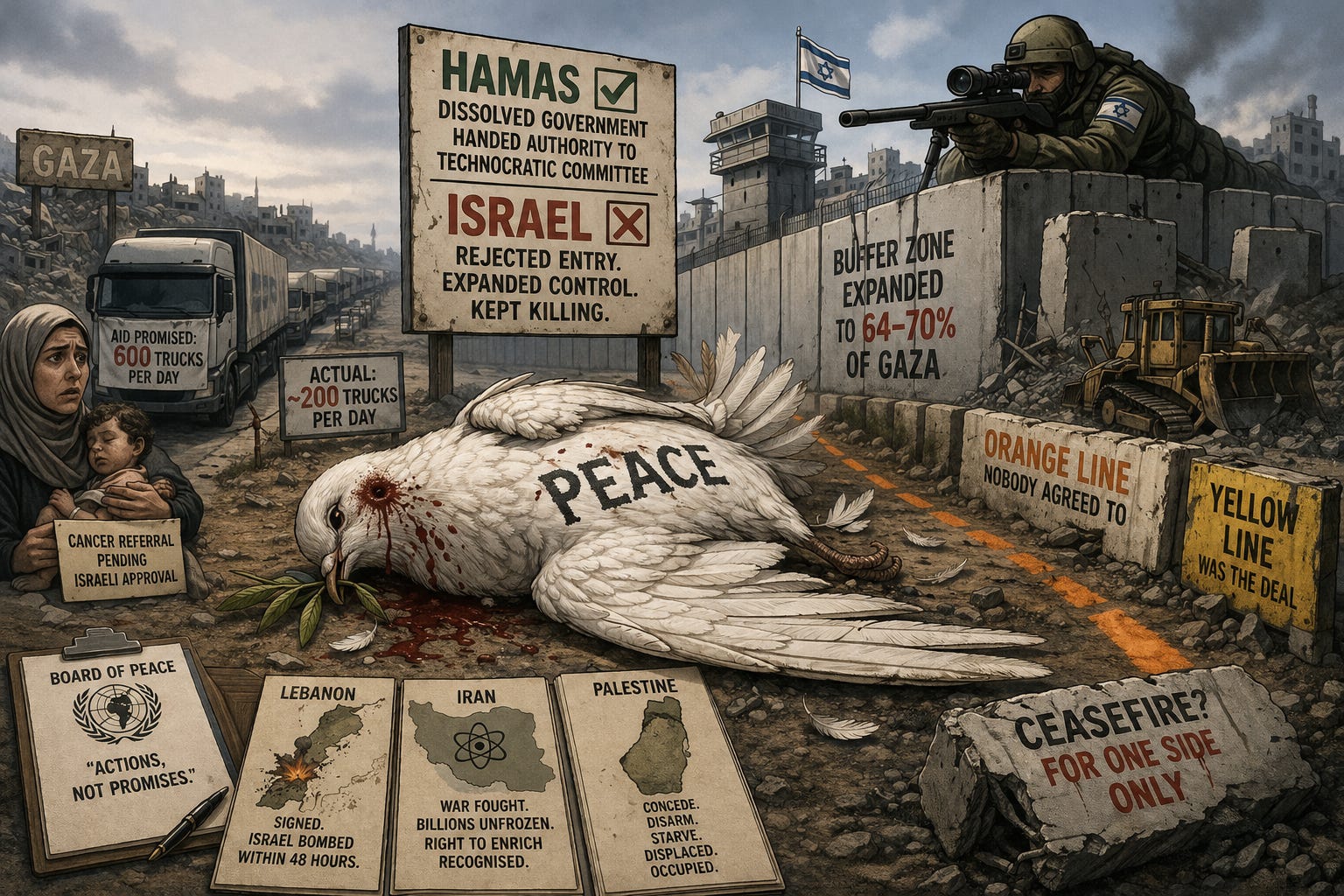
The Dove of peace is dead: Shot in the head by an Israeli sniper. Israel never wanted peace. The Board of Peace never wanted peace. And if you’ve spent the last nine months assuming otherwise, congratulations — you’ve been paying exactly the kind of attention the process was designed to reward.
Let’s cut through the BS, because there’s a lot of it, and most of it is coming from people who’d like you to believe spin is something only the other side does.
On Monday (6th July 2026), Hamas did something that would have been unthinkable a year ago. It dissolved the Emergency Committee that has run Gaza’s civil administration since 2007, formally resigning its governing authority and handing responsibility to the National Committee for the Administration of Gaza — the technocratic body created under Donald Trump’s Board of Peace framework. The move was largely symbolic as Hamas prepares to transfer authority, though there was no clear commitment on disarmament. Still, symbolism matters when a movement has run a territory for two decades. Hamas said it hoped for the “swift entry” of the NCAG and affirmed its readiness to hand over governmental responsibilities to ensure the committee’s success, while Hamas’s government media office head Ismail al-Thawabta said all 60,000 or so civil servants would keep working, this time under NCAG authority, to avoid total civic collapse. The group’s spokesman was refreshingly blunt about the motive, telling AFP the decision was designed to “remove any pretexts for the occupation, which continues its aggression and war of extermination.”
You’d think this would be the good news day. A twenty-year governing apparatus stepping back, a technocratic Palestinian committee ready to walk in, a chance to actually test whether the “peace” in “peace plan” means anything. Here is what Israel had to say about it instead: an Israeli official told the public broadcaster Kan the move was “spin without any meaning,” suggesting Hamas was “stalling and engaging in spin” because it feared being declared in violation of the ceasefire. Even the Board of Peace itself, Trump’s own creation, could only manage a shrug, saying its “assessment will be guided by actions, not promises.” Actions. Not promises. A fine standard. One that, as we’re about to see, gets applied to precisely one side of this ceasefire.
Because while Hamas was busy resigning things, Israel was busy annexing them — quietly, in the way that’s become house style for this occupation.
Under the original October 2025 ceasefire map, Israeli forces withdrew to a demarcation known as the “yellow line,” which handed Israel military control of roughly 53 percent of Gaza. That was the deal. That was, allegedly, the temporary arrangement pending phased withdrawal. Then the line started moving. By May 2026, Israel said it had increased its control to 60 percent of the Gaza Strip, and Prime Minister Benjamin Netanyahu ordered the military to push that figure to 70 percent. Aid groups were quietly handed an updated map in late March showing a new “orange line” — international organizations reported the new boundary put Israeli control at around 64 percent of the territory. Nobody voted on this. Nobody signed a new agreement for this. The line just crept, block by concrete block, west toward the sea, the way an occupying force’s promises tend to do when nobody’s holding a stopwatch.
And it isn’t subtle, either. Residents in Gaza City’s Tuffah neighbourhood told The New Arab that Israeli forces have continued moving the concrete blocks marking the “yellow zone” since the ceasefire came into effect, displacing families who go to sleep believing they’re outside the danger area and wake up to discover the boundary has moved overnight. Civil defence spokesman Mahmoud Bassal put it more plainly than any diplomat has managed in nine months: “The line is not fixed.” Turns out that’s true of quite a lot involving this ceasefire.
This is the part of the story where, if you were a certain kind of Western commentator, you’d reach for the word “complicated.” It isn’t complicated. It’s a protection racket with a UN Security Council resolution number.
Let’s follow the logic all the way through, because the layering here is the whole point. Nikolay Mladenov, the Board of Peace’s own director-general — the man literally employed to make this process work — stood in Jerusalem in May and admitted the quiet part out loud. He warned that failure to advance the agreement would entrench “a dangerous status quo,” leaving two million Palestinians without a viable future while Israel’s long-term presence across more than half the territory became permanent.
He didn’t mince the casualty figures either: Israel has carried out near-daily airstrikes in Gaza, killing more than 850 people since the ceasefire took effect, according to the Palestinian Ministry of Health. Read that again. Eight hundred and fifty deaths. Since the ceasefire. That is the death toll of an active war zone being reported by the person in charge of overseeing peace.
Meanwhile, the humanitarian numbers are their own small horror show of ratios. Israel agreed under the ceasefire to allow 600 aid trucks into Gaza per day. Human Rights Watch found that when Israeli-US operations against Iran began in late February, Israel closed all crossings entirely, and weekly truck entries collapsed from an average of 4,200 to just 590 — a shortfall so severe it makes “underdelivering” sound generous. Palestinian officials in Gaza put the real figure even lower: Gaza’s Government Media Office head told Anadolu Agency that Israel was allowing “no more than 200 aid trucks” a day, roughly a third of what was promised, warning malnutrition levels had exceeded 90 percent of the population. A mother in Khan Younis, waiting for her two-year-old daughter’s stomach cancer referral to clear an Israeli-controlled crossing, told +972 Magazine something that should embarrass every diplomat who signed this thing:
“If this is a real ceasefire, why is Israel still closing the borders and restricting the entry of life-saving necessities?”
It’s a good question. Nobody with the power to answer it seems interested in trying.
Now widen the frame, because Gaza isn’t operating in isolation — it’s the pilot episode of a franchise. Lebanon signed a US-brokered framework in June, its government agreeing to recognise Israel and pursue Hezbollah’s full disarmament in exchange for eventual Israeli withdrawal. The text didn’t require Israel’s unconditional withdrawal — it tied any pullback to Hezbollah’s disarmament, a condition the group has repeatedly rejected. Israel resumed air strikes on southern Lebanon within two days of signing it, and Defence Minister Israel Katz confirmed Israeli forces were preparing for an “extended stay” in the buffer zone regardless. Sound familiar? It should. It’s the same yellow-line playbook, exported. A Beirut-based academic writing for Mondoweiss called it exactly what it is back in April, months before it played out on schedule: a strategy of creating facts on the ground militarily with no political opposition, then consolidating them in prolonged, one-sided ceasefire deals with US support — a template that, if it holds in Lebanon, can be repeated in Syria or the West Bank.
And then there’s Iran — the supposed crown jewel of concessions extracted through the February war. Here the hypocrisy achieves something almost structurally elegant: it inverts itself. The Islamabad Memorandum, signed in June after a war explicitly launched to dismantle Iran’s nuclear programme, didn’t actually dismantle Iran’s nuclear programme. Analysis from the Iran Watch project found the deal settled for a set of terms giving Iran an economic windfall while demanding little in return — Iran’s uranium enrichment future was left to a “final agreement” still to be negotiated, and the memorandum explicitly recognised “Iran’s nuclear needs” as informing the scope of future enrichment work. In exchange, the US agreed to waive sanctions on Iranian oil exports and unfreeze tens of billions of dollars in restricted Iranian funds.
So: a war was fought, a country was bombed, an off-ramp was needed, and Iran walked away richer and with its “right to enrich” argument tacitly conceded — while Gaza, whose governing authority actually dissolved itself on schedule, gets “spin without meaning” as a review. Arms control analysts weren’t much kinder about the strategic logic behind any of it. The Arms Control Association noted the June 2025 strikes severely damaged Iran’s enrichment facilities but did nothing to its resolve to retain a nuclear programme or its underlying know-how, and independent nonproliferation reporting concluded the war has made monitoring Iran’s nuclear programme harder, not easier — trading transparency for destruction and diplomacy for a widening conflict whose nuclear outcome is now less certain than before it started.
So here’s the ledger, laid out plainly, because layering only works if you can see all the layers at once:
Hamas dissolved a government. Israel expanded a buffer zone. Lebanon signed away sovereignty on paper; Israel kept bombing it within 48 hours. Iran got billions unfrozen and a tacit nod to keep enriching; Gaza got 200 trucks a day instead of 600 and a two-year-old waiting on a cancer referral that Israeli border policy won’t clear. Every single mechanism in this “peace architecture” — the Board of Peace, the yellow line, the MOU, the pilot zones — was built with an exit ramp for exactly one party, and it isn’t the one being asked to disarm.
This is the part where the West’s finest institutions would like you to conclude that “both sides” bear responsibility for the stalemate, that peace is hard, that these things take time. Perhaps. But time, in this arrangement, only ever seems to run in one direction: toward more territory, more buffer, more “orange lines” nobody agreed to, and fewer trucks.
Hamas’s political concession this week was real. Israel’s response to it — refusal to let the replacement committee so much as enter the territory it’s meant to administer — was the tell. You don’t reject a transition to civilian technocratic rule if the goal was ever civilian technocratic rule. You reject it if the buffer zone is the point.
The catch-22 writes itself, because Israel wrote it: disarm, but we won’t let anyone else govern. Step back, but we’ll keep advancing. Concede, but we’ll keep the land anyway.
It isn’t a peace process. It’s a ratchet, and ratchets only turn one way.
This article was very informative and interesting. Keep up the good work 👏.
Hamas is checking all the boxes to demonstrate its legitimacy to the world. Meanwhile, the Qassam Brigades, PIJ, and the other factions are fully prepared for not only a long war of attrition, but also renewed offensive operations. The occupation rats have grown soft and comfortable in Gaza, while the cat sharpens its claws and stalks its prey. "Victory comes with patience." -Abu Obeida.