


Foreward:
Abood is one of the coordinators for Gaza’s Forgotten Families Initiative, and for the last few weeks he’s been tied up doing the daily water distribution—often twice a day—in the camps that barely get any attention, especially the ones out near the yellow line where most initiatives don’t reach. He does all of this voluntarily, without taking any pay for himself. Now that he finally had a moment to breathe, he was able to write a personal piece that means a lot to him, and hopefully you take the time to read it. If you want to show him some appreciation and support, you can do so at the following link:
For me, the second my father was taken, I felt as though I was no longer living the life I once knew. In that single second, my childhood came to an end. A new life began—one I didn’t choose, but one that was forced upon me.
We left my father behind and journeyed into the unknown toward Rafah. We had nothing but a few pieces of wood and fabric to construct a tent that would become our new home. I wasn’t thinking about fear, displacement, or the war itself back then; a single question consumed my mind: How am I going to feed my family?
For the first time in my life, I began to think the way my father used to. I became responsible for an entire family. I didn’t know much about working, aside from simple things my father had taught me when I was little, but I knew that giving up was not an option.
I started searching for a small business idea—something that wouldn’t require a large capital and could provide us with a modest income. I sat with my mother for a long time before making any decision, because the money we had was all we had left. Even her wedding ring became part of our starting capital.
It was a terrifying decision, but it was also a doorway of hope.
I bought some groceries and set up a small street stall in the Rafah market. My brother helped me; I would sit all day selling goods, and then he would come take my place for an hour or two so I could go fetch water for our family.
Selling and buying weren’t the hardest part of my life.
The hardest thing was the water.
I used to carry two containers, each with a capacity of twenty liters—forty liters of water in total—and walk with them for more than 750 meters to reach our tent.
That water journey drained both my body and my soul. Even today, whenever I smile and recall those days, that exhaustion returns to steal my smile away.
The small business generated around fifty shekels a day—an amount far from enough to sustain a family of seven. Every time we needed money, I had to take a portion from our capital just so we could buy food.
Then came the day that changed everything.
I woke up and went to the market, only to find people buying everything frantically. Some wanted to buy out my entire stall at once.
I understood then that the border crossings had been closed, and that food supplies were about to vanish.
I sold only a portion of the goods and refused to sell the rest, knowing that my family would be the first to need them.
The next day, I went to the wholesale market to restock.
And there... I received one of the biggest shocks of my life.
Prices that had remained stable my entire life had multiplied several times over. I couldn’t even buy ten kilograms of sugar with the amount I had originally used to launch the entire project.
I returned to the tent broken-hearted.
I told my mother that the project was over.
She smiled calmly and said:
“Our sustenance is written in the heavens... and God never forgets His servants.”
Her words were greater than any wealth.
We continued to pray as my mother advised, but the days grew increasingly harsh.
The provisions began to run out.
The money was almost gone.
And hunger drew closer to us than ever before.
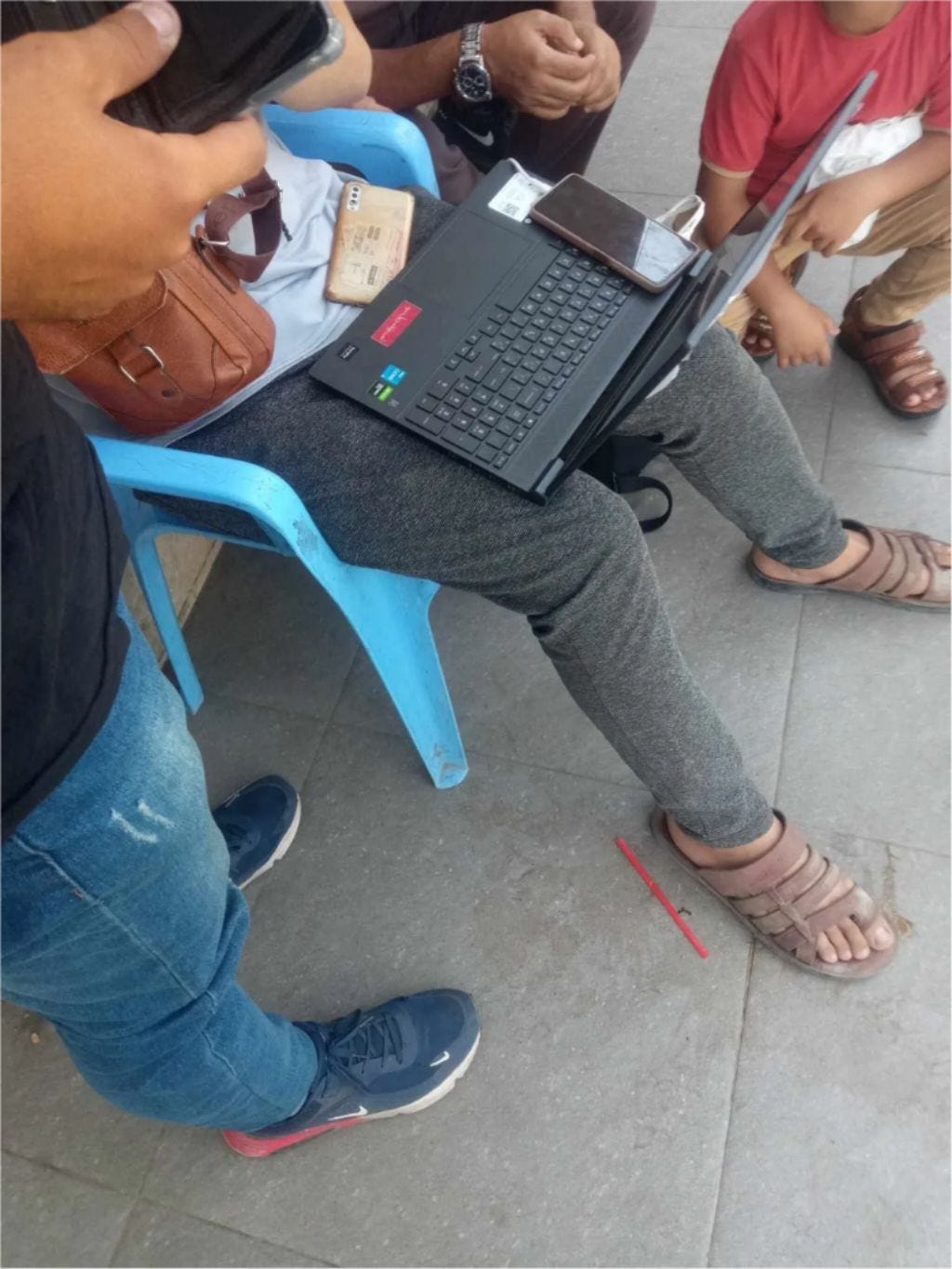
One day, I went to charge my phone and my sister’s laptop—the last thing we had left from our home.
I overheard a group of young men talking about the internet blackout and how they spent their nights doing nothing but waiting for the unknown... or waiting for a missile.
Right then, an idea struck me.
Why don’t I sell movies and TV shows?
Many people laughed at the idea. But I was confident it would work.
Because even in the heart of war, people need a moment to forget death and give their children an hour of laughter.
Just two weeks later... the idea succeeded beyond anything I had expected.
My income became double what I used to make from the grocery stall. People started flocking to get movies, series, and kids’ films, while I explained the content to them, drawing on my passion for cinema from before the war.
For the first time, I felt like I was truly able to save my family a little.
But war never allows joy to last.
Three months later, the occupation forces began threatening Rafah, forcing hundreds of thousands of families to flee once again.
I went alone to Deir al-Balah, then to Khan Younis, searching for any spot to pitch our tent.
I found nothing.
Until I saw a man taking down his tent after his family was martyred in northern Gaza; he was trying to return north.
I took the spot where his tent had stood.
It was not an easy feeling. But we had no choice.
Only one problem remained: How would we pay for the transportation of the tent and the family?
And here came the final farewell...
The farewell to my mother’s ring.
She sold it so we could make the move.
And I never saw that ring again.
We settled in Khan Younis. But the internet returned, and the idea of selling movies spread everywhere.
I was happy that people found a source of entertainment—yet sad that my livelihood had come to an end, once again.
Just two days later, a friend told me that there were people from outside Gaza who wanted to help us.
I didn’t believe him.
How could people who didn’t know me, and didn’t speak my language, care about me?
Those closest to us had failed us... so how could strangers help?
But I was wrong.
I discovered that humanity doesn’t require a single language, a single nationality, or a single religion.
It is enough for a human being to simply be human.
I needed help, but I didn’t know how to ask for it. I wanted people to help me because they wanted to, not because I forced them to hear my story.
I wanted to know why they were doing this.
And today... I know the answer.
Because they saw us as human beings.
The first person I met was from the United States. I was afraid at first. But in less than a week, everything changed.
That person created the very first fundraising campaign for my family. He taught me things I didn’t know.
Then, by chance, I joined X (formerly Twitter) and saw foreigners talking about Palestine, even translating the news into Arabic.
That was when I realized the world hadn’t forgotten us.
Through those conversations, I met two people who became some of the dearest individuals to my heart.
They never let me down.
They never hurt me with a single word.
They constantly encouraged me, treating what I was doing as something worthy of respect.
They supported me financially and emotionally.
For over two years now, nothing has changed. They remain just as faithful, loving, and full of faith in what I do.
And I don’t think words of gratitude alone could ever give them the appreciation they deserve.
To every person who stood with Palestinians...
To everyone who donated, shared a story, wrote a word, prayed for us, or refused to stay silent in the face of genocide...
Thank you.
We will never forget where you stood for as long as we live.
History will record that you chose to stand with humanity, not with oppression.
As for you—who have become so much more to me than just supporters...
You are friends and family, brought together not by borders, but by humanity.
I love you, and I thank you from the bottom of my heart.
This should read and discussed in every school during history lessons! And published on the front-page of sheeple’s MSM agit-prop pamphlets.
What a beautiful article of faith and hope...it brought tears to my eyes. You are not forgotten ❤️