


France’s decision to call more than thirty African leaders to Nairobi did not come from confidence. It came from fear. The political map of West Africa is shifting, and Paris is losing the ability to shape events the way it once did. The breakaway of Mali, Burkina Faso, and Niger through the AES alliance was only the most visible sign. The deeper change is happening across the continent, where governments and citizens are questioning the entire structure of French involvement.
African research institutions have been tracking this shift long before the Nairobi meeting. The Council for the Development of Social Science Research in Africa in Dakar has published studies showing how public opinion in Francophone countries has turned sharply against France over the last decade. The Institute for Security Studies in Pretoria has reported that African states are diversifying their military partnerships because French security operations failed to deliver stability. Analysts in Bamako and Ouagadougou have argued that France’s presence created dependency rather than resilience.
These findings are echoed by media outlets across the continent. Senegal’s SenePlus, Kenya’s The EastAfrican, and Maliweb have all described a growing frustration with the way France frames its role. The common theme is that France expects loyalty while offering limited political space for African governments to make independent choices. This is not a new critique. It is simply becoming harder for Paris to ignore.
The AES departure accelerated everything. When those governments removed French troops and cancelled long‑standing agreements, they demonstrated that the French system is not permanent. They showed that a state can reject the CFA franc, expel foreign soldiers, and still maintain international partnerships. Russia, Turkey, China, and the Gulf states have all expanded their presence in the region, giving African governments more options than they had twenty years ago.
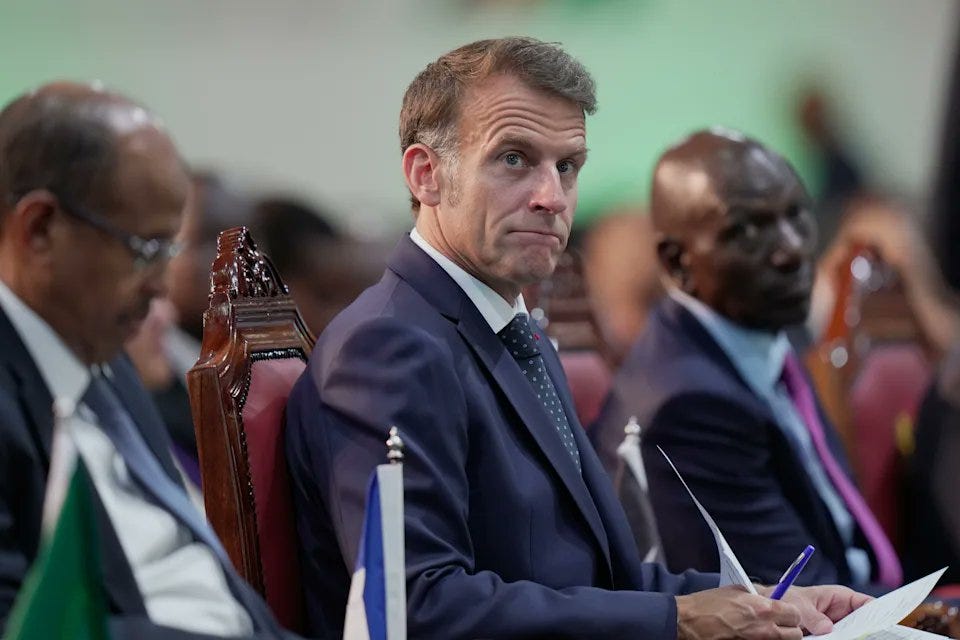
This is the context behind Macron’s Nairobi gathering. It was not a celebration of cooperation. It was an attempt to stabilize a network that is coming apart. African journalists noted that the meeting’s agenda was vague, the goals unclear, and the tone unusually urgent. Leaders were reminded of development programs, military support, and financial ties. The message was subtle but unmistakable. Do not follow the AES. Do not disrupt the currency system. Do not shift your alliances too quickly.
African scholars have pointed out that this approach reflects a deeper problem. France still treats African states as if their choices must align with French interests. Political scientists at the University of Ghana and the University of Dar es Salaam have written that France struggles to accept African strategic autonomy because it would mean losing the influence it built after independence. Economists in Cameroon and Côte d’Ivoire have argued that the CFA franc remains a symbol of this imbalance, keeping monetary policy tied to Paris rather than African priorities.
The Nairobi meeting exposed this tension. If France saw African states as equal partners, it would not need to summon them. It would not need to warn them about the consequences of shifting alliances. It would not need to frame sovereignty as instability.
The real story is that African states are changing faster than France can adapt. Younger populations are demanding independence in foreign policy. Civil society groups are challenging old agreements. New economic partners are offering alternatives. The monopoly France once held is gone.
Macron’s gathering was an attempt to slow this process. But the political landscape has already moved. The AES departure was not an isolated act. It was a signal that the old order can be rejected. Other governments are watching, and their publics are pushing them to reconsider long‑standing ties.
France can call more meetings. It can issue more warnings. But the continent is no longer operating on French terms. The Nairobi summons showed that clearly. The question now is whether France will adjust to a new reality or keep trying to preserve a system that is already breaking apart.
France: The Evil Empire
youtube.com/watch?v=yrmbCiGwO1g
The French can't keep their claws of resource rich Africa! All France produces are weapons, cheese and wine, not enough to be as rich as they are