


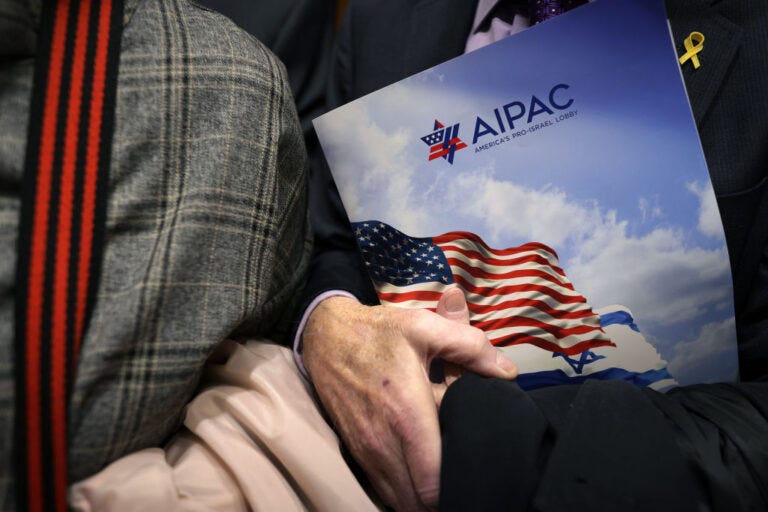
AIPAC presents itself as a bipartisan nonprofit devoted to strengthening the U.S.–Israel relationship. Beneath that surface, however, lies a long and well documented record of secrecy and manipulation. Over the decades, AIPAC and its allies have been investigated for espionage, theft of classified information, and unlawful coordination with the Israeli government.[1]
What began as a foreign information office has now become a lobbying empire with immense control over elections, legislation, and media narratives. The organization’s influence operates through a sophisticated network of donors, think tanks, and political operatives, including the Washington Institute for Near East Policy, the Virginia Israel Advisory Board, and a constellation of political action committees that fund both Democrats and Republicans. Together, they have turned the defense of Israeli policy into a litmus test for American political loyalty.
Today, AIPAC’s reach extends from Capitol Hill to college campuses, funding campaigns, shaping public messaging, and promoting laws that equate criticism of Israel with antisemitism. The result is a system in which questioning Israeli policy can cost a person their career, contract, or credibility. Understanding how that power developed, and how espionage, money, and legislation intertwine, is essential to understanding the erosion of genuine democratic debate in the United States.
The Beginning
AIPAC’s story begins with Isaiah L. Kenen, an Israeli government press officer in New York after 1948. Declassified FBI and State Department files show that Kenen received instructions from Reuven Shiloah and Moshe Sharett on how to shape U.S. opinion and policy toward Israel.[2] In 1951, the Justice Department questioned whether Kenen’s activities required registration under the Foreign Agents Registration Act.
Rather than comply, Kenen rebranded his office as an independent nonprofit called the American Zionist Committee for Public Affairs, which later became AIPAC.[2] That strategic pivot allowed the organization to act as Israel’s lobbying arm while claiming to represent U.S. citizens.
Through media outreach and congressional access, Kenen built bipartisan alliances that guaranteed military aid and diplomatic cover for Israel. By the 1970s, AIPAC had become Washington’s most feared special interest group, an entity politicians courted but rarely crossed.
Early Espionage Concerns
In 1984, the FBI investigated AIPAC for espionage and theft of government property after officials obtained a classified U.S. International Trade Commission report.[2] The document contained sensitive, nonpublic data about American manufacturers and trade conditions, including proprietary information that would have given a significant advantage in negotiations. It was then used to lobby Congress in support of a U.S.–Israel Free Trade Agreement, one of the first such agreements the United States entered into. When investigators traced copies of the report back to AIPAC, the case raised serious concerns about how classified economic intelligence was being obtained and used to influence U.S. policy.
Despite the severity of the breach, the investigation did not result in criminal charges. The case was quietly dropped, and no individuals were held accountable. Meanwhile, the policy outcome remained unchanged. The Free Trade Agreement moved forward and was ultimately approved, illustrating how access to sensitive information could be leveraged for political gain without meaningful consequences. Critics point to this episode as an early example of a broader pattern, where national security concerns intersect with lobbying efforts, but enforcement stops short of challenging the institutions involved
Intelligence Scandals and Patterns
The pattern of intelligence-related controversies continued with multiple high-profile cases. In 1985, Jonathan Jay Pollard, a U.S. Navy intelligence analyst, was arrested for spying on behalf of Israel.[3] Over eighteen months, he passed thousands of classified documents to Israeli handlers. A CIA damage assessment later concluded that his actions compromised U.S. intelligence sources across the Middle East.[3][4] Although Israel initially denied responsibility, it later granted Pollard citizenship and welcomed him as a hero after his release in 2020.
Two decades later, a similar case emerged. In 2005, Pentagon analyst Lawrence Franklin and AIPAC officials Steven Rosen and Keith Weissman were indicted under the Espionage Act for leaking classified material to Israeli diplomats.[5] Franklin pled guilty, AIPAC fired the staffers, and prosecutors eventually dropped the charges under political pressure.
Another major intelligence scandal involved the Anti-Defamation League, which operated an illegal intelligence network during the 1980s and early 1990s targeting activists critical of Israeli policy. An FBI raid uncovered thousands of confidential files compiled using police sources.[6] Some of this information was shared with Israeli and South African intelligence services.[7] Civil lawsuits followed, but no executives were criminally charged. FBI files later described the operation as a foreign intelligence gathering network operating under the cover of civil rights work.[6][7]
Electoral Influence and Messaging Control
At the same time, AIPAC’s influence expanded into elections, media, and public discourse. Its United Democracy Project has spent millions to defeat candidates critical of Israeli policy, including Summer Lee and Andy Levin, and has targeted figures such as Ilhan Omar, Rashida Tlaib, and Jamaal Bowman.[9][10] Funding comes from wealthy donors and coordinated PAC networks, creating a system in which even mild dissent can carry political risk.
Think tanks like the Washington Institute for Near East Policy provide congressional testimony and media framing that consistently support Israeli positions. Leaked documents indicate coordinated messaging that promotes unconditional aid and frames humanitarian criticism as hostile propaganda. This influence extends into private platforms, where events featuring Palestinian speakers have been canceled after pressure campaigns.[11]
Redefining Antisemitism and Speech
Efforts to redefine antisemitism have also played a central role. Organizations such as AIPAC and the Anti-Defamation League have pushed for widespread adoption of the International Holocaust Remembrance Alliance definition, which includes examples that critics argue blur the line between antisemitism and political criticism of Israel. In practice, this has meant that speech condemning Israeli government policies, including discussions of occupation, apartheid, or calls for boycotts, can be labeled as discriminatory under certain interpretations. The Antisemitism Awareness Act, reintroduced in 2025, seeks to embed this definition into U.S. civil rights law by directing federal agencies to use it when evaluating claims under Title VI.[12] If applied broadly, this would give institutions a legal incentive to restrict or penalize speech that falls within those examples, particularly in academic settings.
The concern is not hypothetical. Universities rely on federal funding, and Title VI enforcement carries real consequences. By tying funding and compliance to a definition that includes political expression, the law could pressure schools to cancel events, discipline students, or limit classroom discussion related to Israel and Palestine. Kenneth Stern, one of the original drafters of the IHRA definition, has repeatedly warned against this exact use, stating that applying it to campus speech risks turning a tool meant to track antisemitism into a mechanism for suppressing debate.[13] Critics argue that this represents a shift away from protecting individuals from discrimination and toward regulating viewpoints, particularly those that challenge Israeli state policy.
Federal Legislation
Alongside these influence campaigns, U.S. legislation has increasingly reflected these priorities. The Israel Anti-Boycott Act proposed civil and criminal penalties for individuals or companies participating in boycotts of Israel that are called by international organizations, including the United Nations.[14] Critics argued that the bill would directly punish participation in political boycotts, a form of expression the Supreme Court has already recognized as protected under the First Amendment. The concern was not just theoretical. The bill’s language was broad enough that ordinary political activity, such as supporting or complying with a boycott campaign, could expose individuals or businesses to legal consequences.
The Combating BDS Act of 2019 took a different approach but led to similar outcomes.[15] Rather than imposing federal penalties outright, it explicitly authorized states to pass their own anti-boycott laws and insulated those laws from certain legal challenges. This helped accelerate the spread of state-level measures requiring individuals and companies to certify that they do not boycott Israel as a condition of receiving government contracts. In effect, the federal government provided legal cover for policies that tie economic participation to political alignment.
More recent proposals have pushed these boundaries even further. Legislation allowing passport denial or revocation for individuals accused of providing “support” to designated organizations raises serious due process concerns, particularly because such determinations can be made without a criminal conviction.[16] The ambiguity of what constitutes “support” creates the potential for political speech or activism to be swept into enforcement.
Another proposal, H.R. 8445, would extend certain legal protections, similar to those granted to U.S. service members, to Americans who voluntarily serve in the Israeli military.[17] This is notable because there are no comparable protections for Americans serving in the armed forces of other allied nations. Taken together, these measures illustrate a broader trend. Legislative efforts are not only protecting Israel from economic pressure and criticism, but also embedding that protection into U.S. law in ways that raise constitutional questions about speech, due process, and equal treatment.
State Legislation and Legal Challenges
At the state level, more than thirty five states have enacted anti-boycott laws that restrict government contracts or investments tied to boycotts of Israel.[18] These laws typically require individuals, businesses, or even sole proprietors to certify that they are not participating in a boycott of Israel as a condition of receiving state contracts. In practice, this means that access to public employment or funding can be contingent on a person’s political position. In Arkansas Times LP v. Waldrip, a newspaper challenged such a requirement after being asked to sign a certification in order to receive advertising revenue from a public university.[19] The Eighth Circuit upheld the law, and the Supreme Court declined to review the case, allowing the policy to stand within that jurisdiction.
In other states, similar laws initially faced successful constitutional challenges. Federal courts blocked versions of these laws in Texas and Arizona, finding that they likely violated the First Amendment by compelling speech and penalizing political expression.[15] Rather than abandoning the approach, lawmakers revised the statutes to apply only to larger contracts or businesses above certain thresholds, effectively narrowing the pool of people able to challenge them while keeping the core mechanism intact. This pattern reflects an ongoing legal strategy of adjusting the laws just enough to survive court scrutiny while maintaining their underlying purpose.
Civil liberties groups argue that these laws conflict directly with the Supreme Court’s decision in NAACP v. Claiborne Hardware Co., which recognized politically motivated boycotts as a form of protected speech and association.[20] By conditioning government contracts on a pledge not to boycott Israel, these policies introduce what critics describe as unconstitutional conditions, forcing individuals to choose between their economic interests and their political beliefs. The fact that these restrictions apply specifically to boycotts of Israel, while other political or consumer boycotts remain protected, raises additional concerns about viewpoint discrimination.[21] Instead of regulating conduct broadly, the laws target a specific political position, creating unequal treatment under the law and reinforcing the perception that one category of foreign policy criticism is being singled out for suppression.
Educational and Cultural Influence
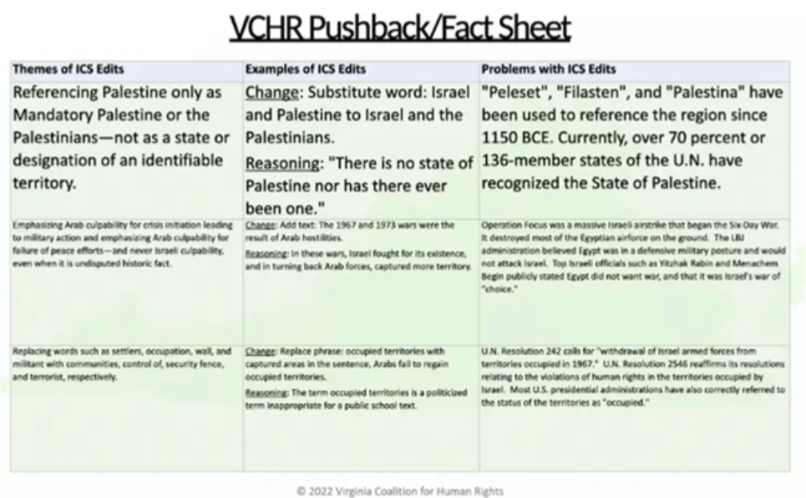
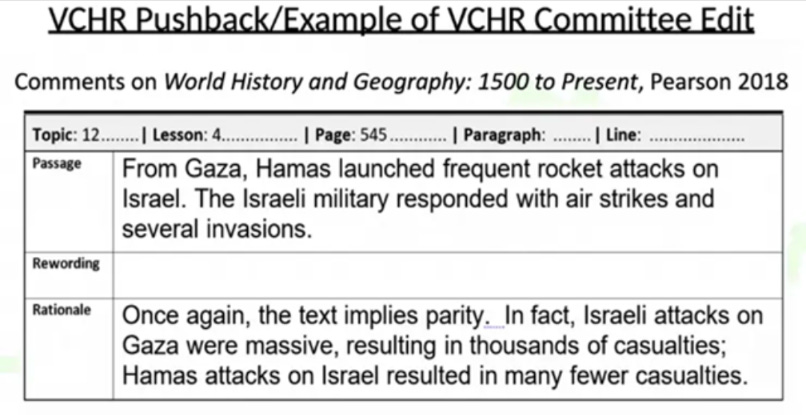
The influence of pro-Israel advocacy extends directly into education, particularly through efforts to shape how Israel and Palestine are taught in U.S. schools. In Virginia, organizations such as the Institute for Curriculum Services worked in coordination with Jewish Community Relations Councils to formally request edits to textbooks and teacher guides, pushing for language changes that reframed Israeli actions and softened or removed references to Palestinian dispossession and occupation.[22][23]
According to reporting by Jeanne Trabulsi, these interventions included altering terminology, discouraging the use of phrases like “occupied territories,” and pressuring publishers to present Israeli policy in a more favorable light. This is not neutral curriculum development. It is targeted political influence over how historical and contemporary conflicts are presented to students, shaping understanding at the earliest stages of civic education.
State-Level Policy and Financial Influence
This influence is not limited to language in classrooms. It also extends into state-level policymaking and public funding decisions. In Virginia, the Virginia Israel Advisory Board has played a key role in directing state resources toward Israeli-linked business initiatives, including facilitating economic partnerships and channeling public funds to projects tied to Israeli companies.[23]
Critics argue that this creates a structural relationship in which state institutions actively promote the economic interests of a foreign country while simultaneously shaping public narratives about it. When combined with textbook influence, this produces a feedback loop where policy, funding, and education reinforce the same perspective. The result is not just advocacy, but institutional alignment that embeds a specific foreign policy viewpoint into both governance and public understanding.
Civil Liberties Concerns
The driving force behind these efforts is a coordinated network often described as the Israel lobby. Organizations such as AIPAC have framed these measures as necessary responses to antisemitism or terrorism, which has helped secure broad bipartisan support.[24] That framing is politically effective because it shifts the focus away from civil liberties and toward moral urgency. Critics argue, however, that this approach conflates the protection of a marginalized group with the protection of a foreign government’s policies, allowing laws that would otherwise face strong constitutional challenges to move forward with less scrutiny.
These developments raise serious civil liberties concerns across multiple areas of constitutional law. Political boycotts and criticism of foreign governments are well established forms of protected speech under the First Amendment.[20] By targeting boycotts of Israel specifically, these laws do not regulate conduct in a neutral way. Instead, they single out a particular political viewpoint for restriction, raising clear concerns about viewpoint discrimination.
The requirement that individuals or businesses certify that they do not participate in such boycotts in order to receive government contracts introduces what legal scholars describe as an unconstitutional condition. It forces people to choose between their economic livelihood and their political beliefs, effectively turning access to public resources into a tool of ideological enforcement.
Proposed passport restrictions add another layer of concern. Legislation that allows the government to deny or revoke passports based on alleged “support” for designated organizations raises due process issues, particularly when those determinations can occur without a criminal conviction.[16] The ambiguity surrounding what constitutes “support” creates the risk that political speech, advocacy, or association could be interpreted in ways that trigger penalties. This shifts significant power to the executive branch while reducing the procedural protections typically required before restricting an individual’s rights.
Taken together, these policies reflect a broader pattern. Instead of protecting civil liberties, they create mechanisms that condition rights on political alignment, expand government authority to penalize speech, and carve out exceptions to constitutional protections in a narrowly defined area. Critics argue that this not only undermines established legal precedent, but also sets a concerning precedent for how easily similar restrictions could be applied to other forms of political dissent in the future.
Public Opinion vs Policy
Polling data shows a growing gap between public opinion and policy. Surveys indicate declining support for Israeli military actions among Americans, particularly younger generations.[25] Despite this, Congress continues to approve aid and related legislation with strong bipartisan backing.
This isn’t Normal
What makes these policies unusual is their explicit protection of a foreign country. The United States has not enacted comparable laws penalizing boycotts of other nations or restricting criticism of its own government. Historically, dissent, including boycotts, has been recognized as legitimate political participation.
From its origins to its current influence, AIPAC represents how lobbying power can evolve into structural control over political discourse. The same network associated with intelligence controversies now shapes laws that regulate speech and activism. Its influence defines the boundaries of acceptable debate, reinforcing a political environment in which dissent carries consequences.
Sorry to say this, but Donald Trump lies like he breathes. He is also a self-centered malignant narcissist, who lacks the ability to empathize with anyone else. the fact that Pam Bondi's replacement immediately says, "let's just forget about the whole Epstein thing" shows how corrupt the entire system is. Trump has forced himself on countless women of ALL AGES throughout his life. Trump has also said, that if your famous and rich enough, "You can grab women by the p***y" He's also a pedophile, and has been mentioned in the Epstien files a record 38,000 times. Now he's started a war in the mid-east, where thousands of innocent people have been killed, including many children. The sooner he gets impeached, and/or removed from office due to health or other reasons, the better off the U.S. AND the world will be. Trump said he would keep the united states out of foreign war. He said he would lower the cost of living. What he has done is bomb Iran despite no imminent threat from them. And as one of the effects of this war, the cost of living for gasoline food, Medical care, housing and many other things continue to cost more. Trump is a clear and present danger to the United States, and the entire world. He needs to resign. The Republicans that have influence on him need to section 25, convince him to resign, and whatever, just get him the hell out of there! Sincerely David Morris, who was born one day long ago in Fort Wayne Indiana.
Israel is given a status of a religion or a church.