


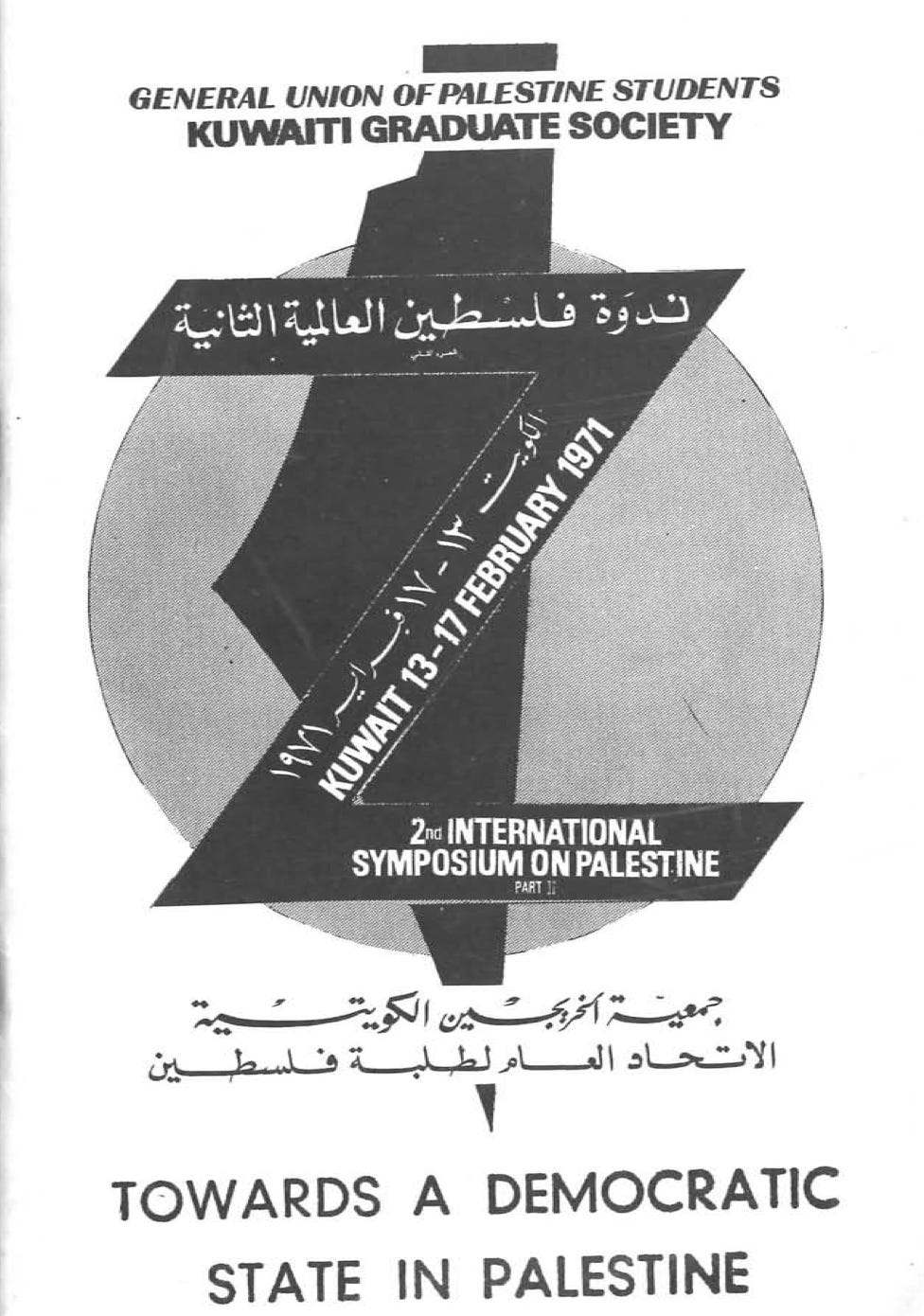
In September 1970, during the Second World Conference on Palestine held in Amman, the Palestine National Liberation Movement (Fateh) presented one of the most remarkable political documents in modern Middle Eastern history. Titled "Towards a Democratic State in Palestine," this comprehensive manifesto articulated a revolutionary vision that challenged both Zionist exclusivity and the vengeful impulses that might naturally arise from decades of displacement and oppression. The document, authored collectively by Fateh's leadership and intellectual cadre, represents a watershed moment in Palestinian political thought—demonstrating how a liberation movement engaged in armed struggle could transcend bitterness to propose a genuinely inclusive future for all inhabitants of historic Palestine
.
The significance of "Towards a Democratic State in Palestine" extends far beyond its immediate historical context. Written at the height of Palestinian armed resistance, just three years after the devastating 1967 Six-Day War and twenty-two years after the traumatic displacement of 1948, the document reveals a political maturity that few revolutionary movements have achieved. Rather than calling for the expulsion or subjugation of Jewish Israelis, Fateh's authors proposed something unprecedented: a unified, democratic Palestine where Jews, Christians, and Muslims would coexist as equal citizens, with leadership determined by merit rather than religious or ethnic identity.
The Evolution of Palestinian Political Consciousness
The Analysis begins by acknowledging the profound transformation that had occurred within Palestinian political consciousness since the launch of armed resistance in 1965. They note that Fateh had officially declared this inclusive political program "almost a year" before the 1970 conference, marking what they describe as a dramatic departure from earlier Palestinian political discourse. This timing is crucial, as it situates the document's vision within the broader context of Palestinian political evolution following the 1967 war, which the authors term "the Second Exodus" (Palestinian exodus).
The transformation described in Fateh's document is particularly striking given the depth of Palestinian trauma following the 1948 Nakba. The authors frankly acknowledge that the displacement of over one million Palestinians had initially fostered widespread anti-Jewish sentiment, noting that "in their misery, humiliation and despair the Palestinians learnt to hate the Jews and everything 'Jewish,' everything connected with their enemy." This honest assessment of Palestinian emotional responses to displacement and occupation provides crucial context for understanding the revolutionary nature of their subsequent political evolution. This recognition allowed Palestinians to understand the real differences between Judaism and Zionism.
What makes Fateh's analysis particularly sophisticated is their recognition that armed resistance, paradoxically, had enabled a more mature and tolerant political perspective. "As paradoxical as it may seem," the document states, "people who fight can afford to be more tolerant. Mental and verbal violence usually accompany helplessness and despair." The authors argue that taking up arms had restored Palestinian dignity and self-confidence, creating the psychological conditions necessary for distinguishing between Judaism as a religion and Zionism as a political ideology.
Systematic Analysis of Zionist Ideology and Practice
One of the most powerful aspects of "Towards a Democratic State in Palestine" is its systematic deconstruction of what the authors call Zionist "image-making"—the propaganda campaign designed to justify Palestinian displacement through systematic dehumanisation. The Fateh authors trace this process from its earliest manifestations in late 19th-century Zionist thought through its contemporary expressions in Israeli policy and international advocacy.
The document's analysis begins with the complete denial of Palestinian existence exemplified by Israel Zangwill's infamous phrase about "a land without people to a people without land." The authors demonstrate how this initial erasure became untenable as the reality of Palestinian society became undeniable, leading to more sophisticated forms of character assassination. They quote extensively from the diaries of Theodor Herzl, the founder of modern Zionism, to illustrate early Zionist attitudes toward Palestinians.
Herzl's writings, as presented in the Fateh document, reveal a chilling dehumanisation of Palestinians that parallels European colonial attitudes toward indigenous populations. The document quotes Herzl's plan to "expropriate gently the private property on the estates assigned to us" and to "spirit the penniless population across the border by procuring employment for it in the transit countries while denying it any employment in our own country." Perhaps most disturbing is Herzl's comparison of Palestinians to "wild animals," writing about using "the natives before giving them employment in the transit countries, for the extermination of these animals."
The authors identify how this dehumanisation evolved into what they term the "mission civilisatrice" narrative, which portrayed Palestinian Arabs as nomadic Bedouins bringing devastation to the "beautiful land of milk and honey," while European Jewish settlers were presented as bearers of superior civilisation. This propaganda framework served a dual purpose: justifying Palestinian displacement while positioning Zionist colonisation as a benevolent modernising force.
The Jewish Moral Dilemma
Perhaps the most penetrating section of "Towards a Democratic State in Palestine" concerns what the authors identify as the fundamental moral contradiction facing world Jewry concerning Palestinian dispossession. The Fateh document grapples seriously with what it calls "THE Jewish dilemma of modern times"—how a people who had suffered persecution could become complicit in the oppression of Palestinians.
The authors draw extensively on Jewish critics of Zionism to support their analysis, particularly the Hebrew philosopher Achad Ha’am, who had warned as early as the 1890s about Jewish behaviour in Palestine. Ha’am observed that Jews in Palestine "treat the Arabs with hostility and cruelty, unreasonably curtail their rights, insult them without any sufficient reason and pride themselves upon such acts." His conclusion that Jews "evidently learned nothing from their history" provides a foundation for the document's broader critique of Zionist practice.
The analysis reaches its culmination in the extensive quotation of American Jewish journalist I.F. Stone, who coined the term "moral schizophrenia" to describe the psychological split affecting world Jewry. Stone, who had been decorated by the Irgun in 1948 but later became a sharp critic of Israeli policies, provided the Fateh authors with a framework for understanding Jewish complicity in Palestinian oppression. Stone argued that "Israel is creating a kind of moral schizophrenia in World Jewry. In the outside world, the welfare of Jewry depends on the maintenance of secular, non-racial, pluralistic societies. In Israel, Jewry finds itself defending a society in which mixed marriages cannot be legalised, in which non-Jews have a lesser status than Jews, and in which the ideal is racial and exclusionist."
This analysis demonstrates the sophistication of Fateh's political thinking, as they avoided simplistic anti-Jewish rhetoric in favour of a nuanced understanding of how historical trauma and political manipulation had led many Jews to support policies that contradicted their own experiences of persecution and their interests in pluralistic societies elsewhere.
The Vision of Democratic Palestine
The core of "Towards a Democratic State in Palestine" lies in its detailed articulation of an alternative political arrangement for historic Palestine. The authors' vision encompasses all of pre-1948 Mandate Palestine, explicitly rejecting any partition solution. As they state, "the homeland of the Palestinians usurped and colonised in 1948 is no less dear or important than the part occupied in 1967." This territorial framework reflects their understanding that the fundamental injustice lay not merely in the 1967 occupation but in the original displacement and colonisation that began in 1948.
The citizenship framework proposed in the document is remarkably inclusive. All Jews, Christians, and Muslims living in Palestine or "forcibly exiled from it" would have the right to Palestinian citizenship, guaranteeing the return of Palestinian refugees while offering citizenship to Jewish Israelis who rejected "Zionist racist chauvinism." Importantly, the authors reject the notion that only Jews who lived in Palestine before 1948 would be acceptable citizens, arguing that ideological orientation rather than date of arrival should determine eligibility.
The governmental structure envisioned in "Towards a Democratic State in Palestine" would be "democratic and progressive," explicitly rejecting "theocratic, feudalist, aristocratic, authoritarian or racist-chauvinistic" forms of government. The authors propose a system providing "equal opportunities for its people in work, worship, education, political decision-making, cultural and artistic expression." Crucially, this would not be a consociational democracy based on religious or ethnic quotas, which the authors explicitly reject using the Lebanese model as a negative example.
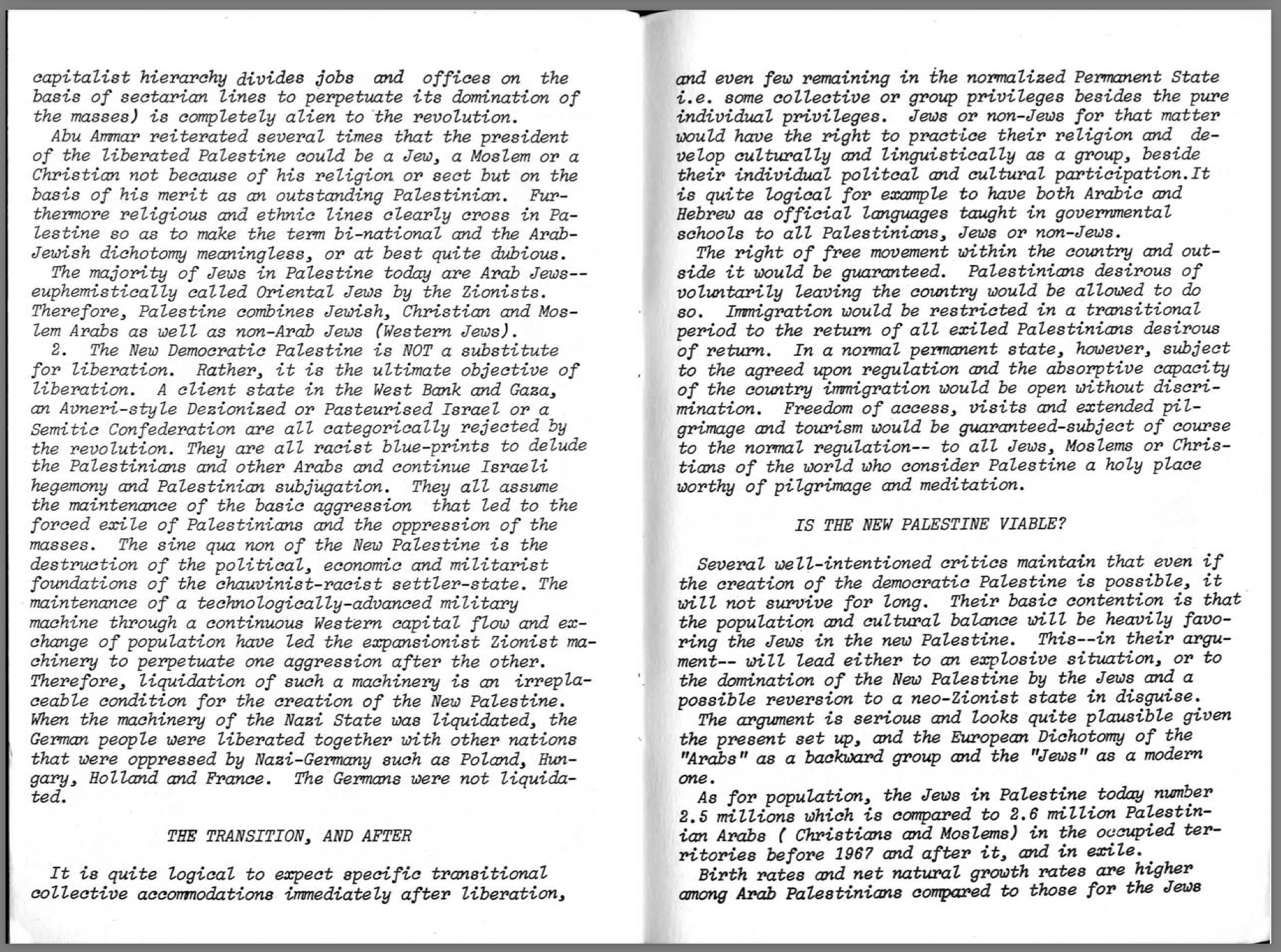
Instead, the document envisions leadership positions filled based on merit rather than religious or ethnic identity. As Fateh leader Abu Ammar stated, "the president of the liberated Palestine could be a Jew, a Muslim or a Christian, not because of his religion or sect, but based on his merit as an outstanding Palestinian." This represents a sophisticated rejection of both ethnic nationalism and religious sectarianism in favour of civic nationalism based on shared citizenship and democratic participation.
Practical Considerations and Implementation
The authors of "Towards a Democratic State in Palestine" demonstrate their political seriousness by addressing practical concerns about the viability of their proposed solution. They acknowledge potential demographic challenges, noting that Jews and Palestinians were roughly equal in number in 1970 (2.5 million Jews versus 2.6 million Palestinian Arabs). However, they argue that several factors would maintain demographic balance: higher Palestinian birth rates, continued Jewish emigration (250,000 Jews had already left Israel by 1970), and the expected return of Arab Jews to other Arab countries as those societies became more tolerant.
The document envisions significant cultural accommodations, including both Arabic and Hebrew as official languages taught in government schools to all citizens. Jews and other groups would maintain the right to "practice their religion and develop culturally and linguistically as a group, beside their individual political and cultural participation." The authors also guarantee freedom of movement and voluntary emigration for those unwilling to remain in the new Palestine, while initially restricting immigration to returning Palestinian exiles.
Economic viability would be ensured through Palestine's integration within the broader Arab world, replacing the existing Arab boycott with economic cooperation and aid. This regional integration would provide the economic foundation that Israel, despite massive Western support, had failed to achieve through its isolation from neighbouring countries.
Revolutionary Practice and Democratic Governance
What distinguishes "Towards a Democratic State in Palestine" from merely theoretical political documents is its grounding in actual revolutionary practice. The authors describe how Palestinian refugee camps in Jordan and Lebanon had already begun implementing democratic self-governance, providing a concrete example of their political vision in action. After "twenty-two years of oppression, humiliation and manipulation by secret police and local exploiters," these camps had "awakened to the revolution" and established self-management systems.
These communities had successfully provided their own medical, educational, and social services while dramatically reducing crime rates. "Self-discipline has replaced the police," the authors note, arguing that this transformation demonstrated the feasibility of their broader democratic vision. The camps had developed what the document describes as a "Net militia" that served as a link between the revolutionary avant-garde and the base of the masses, with "democratic checks built in."
Perhaps most significantly, the document highlights the political development of the "Ashbal" (lion cubs)—Palestinian children aged 8-16 who had grown up in the revolutionary camps. These young people, the authors argue, were "almost free of any anti-Jewish biases" and possessed "a clearer vision of the New democratic Palestine than that held by bourgeois city-dwellers." They represent the generation that would "complete the destruction of Israeli oppression and the rebuilding of the new Palestine."
Military Ethics and Revolutionary Conduct
The authors of "Towards a Democratic State in Palestine" also address the ethics of their armed resistance, demonstrating a sophisticated understanding of the relationship between means and ends in revolutionary struggle. They note that guerrilla operations primarily target the "military and economic foundations of the Zionist settler-state," with civilian casualties minimised whenever possible.
When civilian areas were targeted, the authors explain, the goal was psychological rather than destructive—to demonstrate that the "racist-militaristic state cannot provide security when it is conducting genocide against the exiled and oppressed Palestinian masses." They provide a specific example of this approach in describing the Dizengoff Street bombing in Tel Aviv, where Fateh guerrillas "delayed the operation three times to choose a place (in front of a building under construction) and a time (12:30 after midnight) to maximise noise but minimise casualties."
This attention to the ethics of revolutionary violence reflects the broader moral seriousness that characterises the entire document. The authors consistently demonstrate their commitment to creating a just society through just means, recognising that the methods employed in the liberation struggle would inevitably shape the character of the liberated society.
Historical Significance and Contemporary Relevance
"Towards a Democratic State in Palestine" represents a unique moment in the history of liberation movements, demonstrating how revolutionary organisations can transcend the cycle of victimisation and revenge to propose genuinely inclusive political alternatives. The document's vision of a democratic, secular Palestine became a cornerstone of PLO policy for many years, though it would later compete with proposals for a two-state solution.
The sophisticated political analysis contained in the document challenged both Arab nationalist orthodoxy and Zionist claims about Palestinian intentions. By systematically distinguishing between Judaism and Zionism, rejecting antisemitism, and proposing an inclusive vision of citizenship, the Fateh authors demonstrated a level of political maturity rarely achieved by liberation movements operating under conditions of occupation and displacement.
From a contemporary perspective, the document's emphasis on democratic governance, human rights, and inclusive citizenship remains relevant to ongoing debates about conflict resolution in Palestine/Israel. While the political landscape has shifted dramatically since 1970, the fundamental questions addressed in "Towards a Democratic State in Palestine"—about the relationship between nationalism and democracy, the possibility of reconciliation after historical injustice, and the construction of inclusive political communities—continue to challenge all parties to the conflict.
Limitations and Critical Assessment
Despite its remarkable political vision, "Towards a Democratic State in Palestine" also reveals certain limitations characteristic of its historical moment. The document's analysis sometimes relies on essentialist categories of "Arab" and "Jewish" identity, even while attempting to transcend them. The assumption that most Jewish Israelis would readily accept Palestinian citizenship after military defeat may have been overly optimistic, underestimating the depth of Zionist ideological commitment and the practical challenges of implementing such a dramatic political transformation. The naivety and underestimation of zionist fanaticism is evident.
The document's treatment of the relationship between Palestinian nationalism and broader Arab nationalism also remains somewhat unclear. While the authors envision Palestine as part of the "Arab Homeland," the specific mechanisms for balancing Palestinian distinctiveness with Arab unity are not fully developed.
Furthermore, the document's confidence in the revolutionary process as a guarantee of democratic outcomes, while historically grounded in the authors' experience of camp self-governance, may have underestimated the challenges of scaling up democratic practices from small communities to an entire state facing enormous internal and external pressures.
Conclusion
"Towards a Democratic State in Palestine" stands as one of the most significant political documents in modern Middle Eastern history, representing a moment when Palestinian revolutionary thought transcended the limitations of ethnic nationalism to propose a genuinely inclusive alternative to both Zionist exclusivity and Arab revanchism. The document's authors—writing collectively as representatives of Fateh's political and intellectual leadership—demonstrated that even liberation movements operating under conditions of extreme oppression are capable of remarkable political sophistication and moral imagination.
The vision articulated in this 1970 manifesto remains relevant not merely as a historical artefact but as a continuing challenge to think beyond the limitations of ethnic nationalism toward more inclusive forms of political community. The document's emphasis on democratic governance, human rights, and the integration of former enemies into a shared political project offers important lessons for contemporary peace-building efforts not only in Palestine/Israel but in other contexts marked by ethnic conflict and historical injustice.
Perhaps most importantly, "Towards a Democratic State in Palestine" demonstrates that political movements emerging from profound historical trauma are capable of transcending bitterness to propose visions of justice that include former oppressors as equal partners in building a more just future. The Palestinian revolutionaries' journey from displacement and despair to this sophisticated political vision represents a triumph of political imagination over the cycle of victimisation and revenge that too often characterises ethnic conflicts.
Whether such a vision remains politically feasible in the contemporary Middle East is debatable, but its moral clarity and revolutionary generosity continue to challenge all parties to the conflict—and indeed, all liberation movements worldwide—to consider how the means employed in struggles for justice inevitably shape the character of the societies that emerge from those struggles. In this sense, Fateh's "Towards a Democratic State in Palestine" remains not just a remarkable historical document but a continuing invitation to political courage and moral imagination in the face of seemingly intractable conflicts. Certainly, similar visions never existed in the Israeli society and academia towards Palestinians since the state was carved up in 1948.
Thank you for sharing this
I think:
I think:
The Core Problem:
The Text Assumes the 1968–1970 Binational Horizon Remains Politically Plausible
The 1970 Fatah program — and the way the text presents it — is grounded in the assumption that a democratic, binational unitary state is a viable conciliatory solution for both Palestinians and Israeli Jews.
This assumption was historically reasonable in the late 1960s and early 1970s, a period when:
a) Israeli settlements were few and not yet irreversible;
b) structural Jewish supremacism had not yet reached its current openly genocidal phase;
c) apartheid was not yet formally articulated by Israel itself;
d) parts of the Zionist left still invoked the language of coexistence and binationalism.
The text reproduces this earlier structure as if it still possessed political density in 2024–2025.
Contemporary Palestinian thinkers argue quite explicitly that this is no longer analytically defensible nor politically beneficial.
Relevant Contemporary Authors
Joseph Massad, The Persistence of the Palestinian Question (2006); Crucifying Palestine (2023):
coexistence with a genocidal regime is structurally impossible and conceptually legitimizing of colonial power.
Jamil Hilal, Where Now for the Palestinian National Movement? (2019):
a democratic single state only becomes thinkable after the end of the colonial structure.
Noura Erakat, Justice for Some (2019) and post-2023 essays:
the one-state framework is often used by Western actors as an ideological displacement that avoids confronting power relations.
Ilan Pappé, The Ethnic Cleansing of Palestine (2006), Ten Myths About Israel (2017):
structural elimination precedes any discussion of constitutional forms.
Salman Abu Sitta, The Atlas of Palestine:
coexistence cannot override the right of return nor the dismantling of settler-colonial architecture.
The text does not reflect any of these shifts. It remains embedded in the intellectual world of 1968–1973, which contemporary scholars now treat as historically important but analytically outdated.
2. The Text Treats Jewish-Israeli Willingness to Coexist as an Open Variable — Which is Inconsistent with Current Social Realities
A central premise of the text is that there exists a sufficiently large segment of Israeli society open to egalitarian political coexistence.
However, empirical data — including the very survey referenced in the original text, showing 82% supporting ongoing atrocities and 53% supporting the physical expulsion of Palestinians — invalidates this assumption.
Contemporary Palestinian thought is clear:
> The problem is not a lack of dialogue; it is the overwhelming social entrenchment of Jewish supremacism within Israel.
Key authors:
Azmi Bishara, The Arab Question (2008):
Israeli political culture is structurally incapable of producing an egalitarian civic identity.
Rashid Khalidi, The Hundred Years’ War on Palestine (2020):
Zionism functionally requires demographic domination.
Tareq Baconi, Hamas Contained (2018), essays 2023–2024:
Israeli society has internalized eliminationism as a consensus position.
Abdel Razzaq Takriti, Monsoon Revolution (2013), post-2023 commentary:
Israeli public opinion is fundamentally shaped by settler-colonial incentives.
The text treats Israeli supremacism as contingent rather than structural — a position contemporary Palestinian scholarship considers analytically untenable.
3. The Text Fails to Recognize the Paradigmatic Shift from “National Liberation + Right of Return” to “Full Decolonization”.
Palestinian intellectual history has moved through several phases:
1. Territorial national liberation (1930s–1967)
2. Revolutionary binationalism and the “democratic state” vision (1968–1982)
3. Human rights and statehood diplomacy (1990s–2010s)
4. Decolonization paradigm (2010s–2024) — the current stage
The text is framed entirely within stage 2, ignoring the conceptual transformations in stages 3 and
4.
In today’s intellectual landscape, Palestinian scholars broadly converge on the following principles:
The issue is not a conflict between equivalent national movements; it is a settler-colonial elimination project.
Constitutional or binational arrangements become plausible only after the dismantling of structures of domination.
As long as genocide, mass displacement, and demographic engineering continue, coexistence frameworks are fantasies.
Representative scholars include:
Yousef Munayyer (2024 essays)
Lana Tatour
Saree Makdisi, Tolerance Is a Wasteland (2022)
Hamid Dabashi, Dreams of a Nation (2006), new essays
Khaled Hroub (Islamic political thought)
The text’s analytical horizon predates these developments.
4. The article Frames Coexistence as a Moral Objective but Fails to Acknowledge the Power Asymmetry
It adopts a universalist moral frame (“shared rights,” “common citizenship,” “conciliation”), treating cohabitation and expulsion as moral polarities.
Contemporary Palestinian theorists argue that:
> Colonized peoples have no moral obligation to formulate coexistence frameworks for their colonizers.
The article unintentionally creates a false moral symmetry between Israeli mass displacement, torture, siege, elimination policies
versus
palestinian hypothetical ability to expel Israelis (which does not exist in material reality).
This is a conceptual error highlighted by:
Edward Said, The End of the Peace Process (2000)
Gary Fields, Enclosure (2017)
Mahmoud Mamdani, Neither Settler nor Native (2020)
The analysis inverts the asymmetry by presenting both sides as if they possessed comparable agency.
5. Why Citing the 1970 Fatah Program Today is Harmful to the Palestinian Struggle
Contemporary Palestinian scholarship identifies three core dangers:
(a) It creates the illusion of a “middle ground.”
Such a middle ground does not exist under conditions of ongoing elimination.
(b) It shifts the terrain from decolonization → reconciliation.
Reconciliation without structural dismantlement is a colonial pacification mechanism.
(c) It reinforces the colonial demand that the oppressed demonstrate moral superiority.
Meanwhile, the colonizer retains full impunity.
By ignoring these critiques, the text reproduces what many Palestinian intellectuals consider:
> a well-intentioned but politically disarming discourse that inadvertently legitimizes ongoing colonial violence.
CONCLUSION
The text reflects an important historical phase of Palestinian thought (1968–1973).
However, presenting it as a viable political framework today is viewed by contemporary Palestinian scholars as:
analytically anachronistic,
morally naïve,
politically counterproductive,
structurally aligned with colonial neutralization strategies.
The most important absence in the text is the foundational insight of current Palestinian political theory:
> No democratic constitutional project is conceivable while one side maintains a genocidal, eliminationist colonial structure — and this side possesses all the coercive power.
Therefore, contemporary Palestinian thought would conclude that the text:
fails to confront the structural nature of Zionist political ideology,
underestimates Israeli social adherence to supremacism,
assumes a colonizing subject that no longer exists (if it ever did),
and shifts the debate from decolonization to constitutional utopianism.
- BIBLIOGRAPHY
Palestinian Thinkers (Secular, Marxist, Islamist, Liberal)
Abu-Lughod, Ibrahim. The Transformation of Palestine.
Abu Sitta, Salman. The Atlas of Palestine.
Baconi, Tareq. Hamas Contained; Post-2023 essays.
Bishara, Azmi. The Arab Question.
Dabashi, Hamid. Dreams of a Nation; Post-Orientalism.
Erakat, Noura. Justice for Some; essays 2023–24.
Hilal, Jamil. Where Now for the Palestinian National Movement?
Hroub, Khaled. Hamas: Political Thought and Practice.
Kanafani, Ghassan. The Resistance Literature.
Khalidi, Rashid. The Hundred Years’ War on Palestine.
Khalidi, Walid. From Haven to Conquest.
Makdisi, Saree. Palestine Inside Out; Tolerance Is a Wasteland.
Massad, Joseph. The Persistence of the Palestinian Question; Crucifying Palestine.
Munayyer, Yousef. Essays 2023–25.
Rouhana, Nadim. Israel and Its Palestinian Citizens.
Said, Edward. The Question of Palestine; The End of the Peace Process.
Shalhoub-Kevorkian, Nadera. Security Theology.
Tatour, Lana. “Conditional Citizenship,” “Settler-Colonial Racialization,” etc.
Takriti, Abdel Razzaq. Essays 2023–25.
Jewish Anti-Zionist and Critical Israeli Scholars
Auerbach, Jerold. The Jewish State.
Butler, Judith. Parting Ways.
Gordon, Neve. Israel’s Occupation.
Pappé, Ilan. The Ethnic Cleansing of Palestine; Ten Myths About Israel.
Peled, Yoav. Shas and the Israeli Working Class.
Shenhav, Yehouda. The Arab Jews.
Zertal, Idith & Akiva Eldar. Lords of the Land.
Settler-Colonial Framework & Global Theoretical Context
Fanon, Frantz. The Wretched of the Earth.
Wolfe, Patrick. “Settler Colonialism and the Elimination of the Native.”
Coulthard, Glen. Red Skin, White Masks.
Mamdani, Mahmood. Neither Settler nor Native.
Smith, Andrea. Conquest.
Legal, Human Rights, and International Documentation
Human Rights Watch, A Threshold Crossed (2021).
Amnesty International, Israel’s Apartheid Against Palestinians (2022).
UN OCHA reports on Gaza (2023–2025).
UN Special Rapporteurs: Francesca Albanese reports (2022–2025).
International Court of Justice filings (South Africa v. Israel, 2023)
But, on the whole, I liked it a lot 😉