


There are times when I prefer to sit alone, away from noise, when I need silence so my mind can become clearer. But silence does not always bring peace; sometimes it brings back memories I have tried so hard to forget—memories of days that will never leave me for as long as I live.
Every time I sit alone, I remember those days when we searched for crumbs of food—days when a person would go out knowing they might not return, just for a little flour or a handful of rice. I used to tell myself to stop recalling those scenes, but how can one forget days when hunger chased people like death itself?
Among all those memories, there is one night that remains in my mind as if it happened yesterday.
It was during the peak of the great famine that almost consumed us all. I received news that aid trucks would enter through a nearby street close to the border. At first, I did not believe it, but I rushed with a friend before sunset to the place where the trucks were said to pass.
When we arrived, we saw trucks heading toward the border, which gave us some hope. But soon we realized the number of young men waiting was enormous, and what was coming might not be enough for everyone.
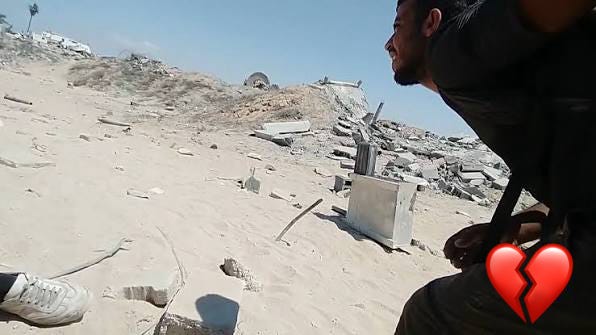
Feb 28, 2024: IDF soldiers take potshots at famished desperate Palestinians
Night fell, and each person began preparing a place to sleep. Some gathered stones to protect themselves from expected gunfire. My friend and I found a barrier of sand and rocks and sat behind it, waiting for the unknown.
Hours passed slowly, and some young men began to leave after losing hope due to the delay of the trucks. We took turns sleeping so we could stay alert.
I was asleep when a huge explosion woke me up. It was a drone dropping bombs over us. We tried to stay calm so we could hear the sound of the bomb being dropped and escape before it exploded. Some did not survive, and others lost their limbs.
Shortly after, we heard tanks approaching, followed by heavy gunfire. I saw the young men at the front running, but they were falling one after another. It looked like people were being hunted.
While we were hiding from the shooting, the trucks began to enter.
I was shocked by the massive number of people. I thought many had left, but I realized a painful truth: hunger kills, and when it becomes extreme, people are ready to face death just to bring food to their families.
My friend and I ran toward the trucks, but we were shocked—they did not stop. They kept moving and crushed anyone in their way. Later, we learned that the drivers had been threatened: if they stopped, they would be targeted.
After about twenty trucks entered, I told my friend we had to climb one of them and try to return home with at least some rice or flour.
With great difficulty, we managed to climb onto a truck full of people. It was so crowded that we almost fell several times. I held onto a metal bar with all my strength while helping my friend stay up.
I reached my hand through the crowd and grabbed one sack of rice, asking my friend to help me pull it.
But suddenly, another hand held the sack tightly.
I tried to make the person let go, but I froze when I saw who it was.
It was an elderly man, over 65 years old, looking at us with eyes full of fear and desperation, saying:
“It is my sack… my children are hungry… please, it is my sack.”
I looked at my friend, and I saw the same question in his eyes as in mine:
How could we take this sack from an old man like this? And how did he even manage to climb onto this truck when we, young and strong, struggled so much?
I said to my friend:
“This is not our day.”
Then I turned to the man and said:
“Don’t worry, we won’t take it. We will help you.”
He looked at us in shock, as if he did not expect to find any humanity left in such a place. He kept praying for us with words that are still engraved in my memory.
That moment, despite everything around it, remains one of the most beautiful moments I have ever lived.
I returned home empty‑handed, and my family was waiting, hoping I would bring something to ease their hunger. I told them what happened, and they said:
“It seems that man also has children waiting for him.”
I slept for a while, then I received news that flour trucks would enter northern Gaza through Zikim.
And then came the miracle I will never forget.
That day, God saved me from death and provided me with a sack of flour for my family.
I reflected on everything and said:
Glory be to God… when I refused to take the rice from that elderly man, God gave me flour on the same day.
This is only a small story among many we lived through during the famine and war. I share it because I trust you, and I believe sincere words should not be wasted.
If this story touches your hearts, help spread it. Not for fame, but so it remains a living testimony of what people here endured—when hunger stood beside death, and humanity still managed to survive against everything
Note: If you want to support Abood A, please consider donating to him or becoming a free/paid subscriber.
– Manufacturing Dissent –
What stays with me in this piece is how, even in a night shaped by hunger and gunfire, the moral center of the story is a simple choice: refusing to survive at someone else’s expense. In a place where the world has stripped people of everything, this young man and his friend still protected an old man’s dignity. That’s not sentimentality — it’s the kind of humanity that survives when every system around it has collapsed.
The contrast is brutal: an army treating starving civilians as targets, and civilians treating each other as family. The people with the least power are the ones still acting with honor. Stories like this matter because they expose the lie that Gaza is defined by violence. What’s actually being documented here is character — the kind that persists even when the world looks away.
Humanity didn’t disappear in Gaza. It’s the only thing that hasn’t.
We have a saying: when one door closes, a window opens. This is a beautiful story, Abood, about generosity over the instinct to self preserve. Ultimately, it is about treating the Other, as you yourself would wish to be treated. But more profoundly, it is about doing the thing you can live with, and maintaining your self respect. I want to praise you, but that would be patronizing. Extreme hunger is a terrible, painful thing that I have never experienced, and the way it has been imposed on you Palestinians in Gaza is sadistic beyond measure. All I can say with any certainty is that beyond generously yielding the bag of rice, you did something much more important, you restored the old man’s faith in humanity and gave him hope, a gift that would have lifted his heart and maybe the hearts of his children, made his life more bearable.