


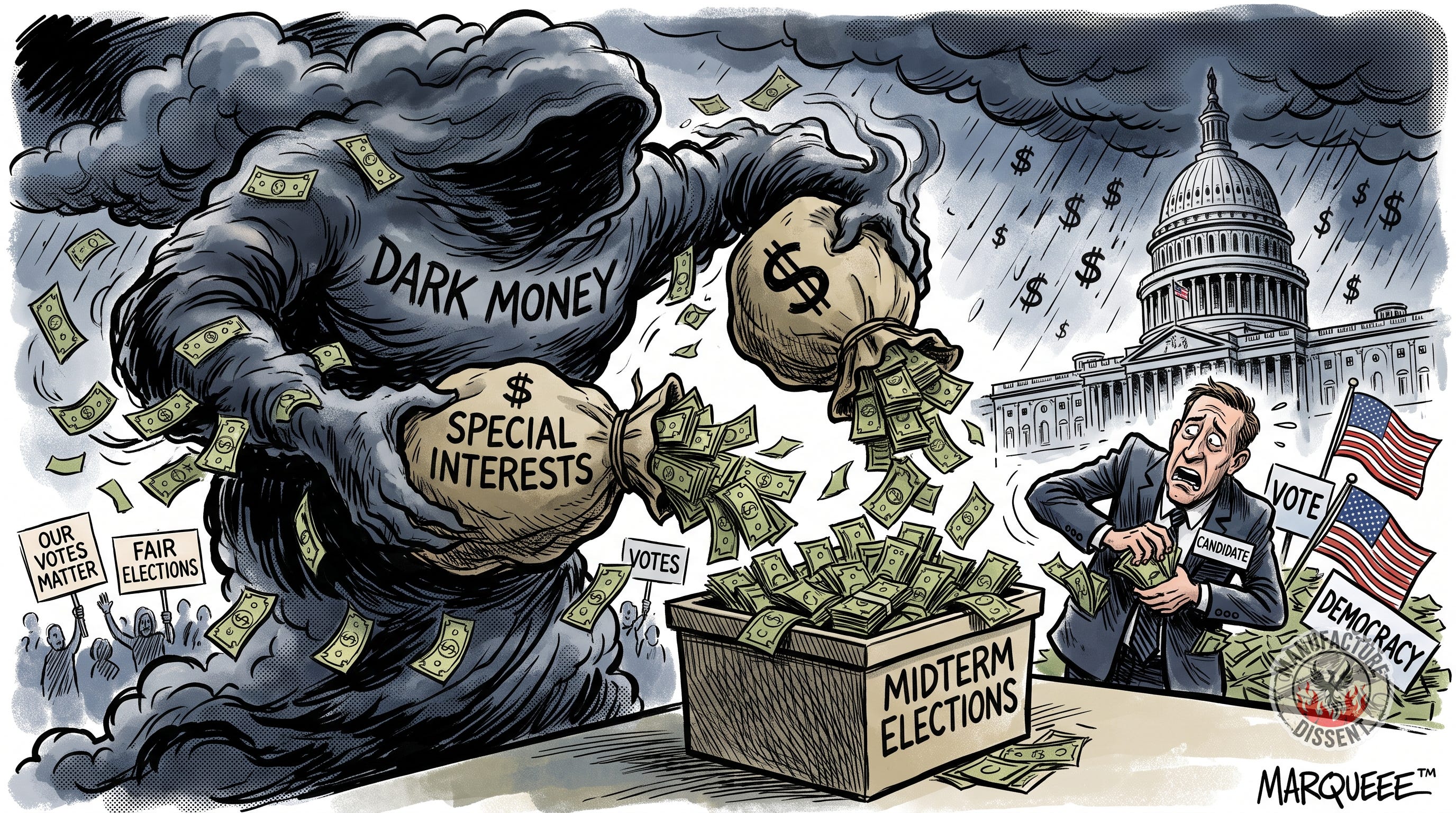
Nearly $1.3 billion has already been spent across 35 Senate races before a single vote is cast. VoteLog.org’s tally of FEC filings shows a political system where the real contest happens long before Election Day—inside donor circles, corporate boardrooms, and political war rooms tied to Israel, big business, and billionaire interests. The money is targeted, strategic, and designed to shape who is allowed to survive in American politics.
The money structure: who is actually paying
Candidate committees
Official campaign accounts for each Senate candidate. They pull in maxed‑out individual donors, corporate PAC money, party‑connected donors, and sometimes self‑funding millionaires. In top races, each candidate can raise $20–$40 million, but that is only a fraction of the total spending.
Party committees
The DSCC (Democratic Senatorial Campaign Committee) and NRSC (National Republican Senatorial Committee) move tens of millions into battleground states. Their donors include wealthy individuals, corporate PACs, and industry associations. They decide which races get life support and which are left to die.
Super PACs and dark‑money groups
Super PACs can take unlimited money from corporations, billionaires, and nonprofits. 501(c)(4) “social welfare” groups can spend heavily while hiding their donors. These entities often outspend the candidates themselves, especially on attack ads. This is where the system becomes completely detached from voters.
Corporate billionaires: the permanent ruling class
Corporate and billionaire money underpins U.S. campaign finance. It comes from:
Wall Street and hedge funds (Citadel, Blackstone, Elliott Management)
Big tech (Meta, Alphabet/Google, Amazon, Microsoft)
Oil and gas (ExxonMobil, Chevron, Koch‑linked networks)
Pharma and healthcare (Pfizer, Johnson & Johnson, major hospital chains)
Defence contractors (Lockheed Martin, Raytheon, Northrop Grumman)
Real estate and private equity (BlackRock, major REITs, private equity firms)
These donors fund corporate PACs, leadership super PACs like Senate Leadership Fund and Senate Majority PAC, and dark‑money policy shops. Their goal is simple: tax policy, regulation, contracts, and foreign policy that protect their profits.
Israel‑aligned political networks: enforcing the Gaza line
Alongside corporate money, Israel‑aligned organisations and donors play a major role in shaping who is allowed to survive in U.S. politics—especially in Democratic primaries and in races where candidates speak openly about Gaza.
Key players include:
AIPAC (American Israel Public Affairs Committee)
United Democracy Project (UDP), an AIPAC‑aligned super PAC
Democratic Majority for Israel (DMFI)
Republican Jewish Coalition (RJC)
Other pro‑Israel donor networks that coordinate spending across PACs and dark‑money groups
These groups spend aggressively. In Michigan’s Democratic Senate primary alone, UDP and DMFI poured over $30 million into backing one candidate and destroying another. Their targets are candidates who call for conditioning U.S. aid to Israel, criticize Israeli military actions, or speak honestly about Gaza.
This is direct, Israel‑aligned political intervention in U.S. elections. It is not vague foreign policy. It is a coordinated effort to maintain U.S. political support for Israel and to eliminate candidates who challenge that support.
How Gaza becomes a political tripwire
When a candidate speaks honestly about Gaza—about bombed schools, dead children, siege, starvation, or war crimes—they step onto a live wire. What happens next is predictable:
Israel‑aligned PACs and super PACs drop millions in attack ads.
The candidate is branded “unsafe,” “extreme,” or “anti‑Israel.”
Their opponent receives a sudden wave of outside support.
Local media is flooded with messaging crafted far from the state they’re running in.
Candidates are erased before voters ever hear their names. This is how foreign‑policy orthodoxy is enforced in the U.S. political system.
Other lobbies in the same game
Israel‑aligned networks are one powerful node in a larger machine. Other major players include:
NRA and gun lobbies
Anti‑abortion networks and religious right groups
Oil and gas lobbies
Pharma and hospital associations
Crypto and tech billionaires
Defense‑industry PACs
Environmental and climate groups
Each can drop tens of millions into a cycle. Each uses super PACs and dark‑money groups. Each shapes which candidates are viable. The system is not controlled by one lobby. Whoever can afford to buy in controls it.
What this looks like in real Senate races
In the most expensive Senate contests:
Total spending per state can reach $100–$200 million.
Outside groups often outspend the candidates themselves.
Negative ads dominate, burying candidates under $10+ million in attacks.
Primaries become the real battlefield, where lobbies quietly erase candidates before the public even knows them.
By the time voters see two names on a November ballot, dozens of potential voices have already been killed off by money.
The brutal truth
The $1.3 billion already spent in Senate races is coming from:
Corporate billionaires and their PACs
Wall Street, tech, oil, pharma, defence, and real estate interests
Party committees funded by wealthy donors
Leadership super PACs like Senate Majority PAC and Senate Leadership Fund
Dark‑money nonprofits hiding their donor lists
Israel‑aligned political networks like AIPAC, United Democracy Project, Democratic Majority for Israel, and others
A web of ideological lobbies on guns, abortion, climate, and more
This is not a system built for regular people. It is a system built for capital and organised power, with Israel‑aligned networks playing a major role in enforcing silence on Gaza.
Regular Americans have no hope in this system because their government is fully bought long before they ever get to vote.
We are a fully subscriber-supported publication. We feature citizen journalists unapologetically. Help us grow and fuel honest, citizen journalism by becoming a paid member.
We always read your comments, don’t forget to share your thoughts with us and our subscribers.
📽️ Credit: Israel Exposed/x